Clinical research blog
Explore our blog for insights into the big questions in precision medicine and clinical research.
Recruiting patients for clinical trials is a crucial component of the drug development process, and a key factor in determining the success or failure of a study. However, finding the right patients is challenging, and many trial sponsors and clinical research organisations (CROs) turn to clinical trial patient recruitment companies and site databases to help identify and enrol suitable candidates. Of course, these resources can be helpful, but for certain types of trials, there are challenges associated with relying on them. In particular, trials looking for patients with particular biomarkers may be too specific to rely on a traditional patient recruitment company or a site database. In this blog, we review these challenges and alternative methods which may address them.
National DNA Day, observed on April 25th, commemorates the discovery of the double helix structure of DNA. It’s an annual, global celebration – and this year, it marks both the 20th anniversary of the Human Genome Project’s completion and the 70th anniversary of the discovery of the DNA double helix. National DNA Day is a day to reflect on the importance of genetics and DNA research in our lives, including the impact it has had on healthcare.
Earlier this month, our team had the pleasure of attending the CMO Summit 360 in Boston. This event brought together top-level medical executives and experts from the biotech industry to discuss the latest trends and innovations in clinical decision making, regulatory strategy, communications, business development, and more. Sano sponsored a table at the event, and was excited to chat with and learn from both attendees and speakers. In this blog, we outline three key themes that emerged throughout the event: understanding the patient, engaging patient advocacy groups (PAGs), and driving diversity in medical research.
If you’re struggling to enroll your trial, you’re not alone. It’s so difficult that nine out of ten trials require the original timeline to be doubled to meet enrollment goals – and when you add in a genetic component, it becomes even more challenging.
This webinar, hosted by Patrick Short of Sano Genetics and featuring Wayne Eskridge and Dr. Neeraj Mistry focussed on the non-invasive screening and genomics in NAFLD (Nonalcoholic fatty liver disease).
With 40% of patients enrolled in clinical trials dropping out prior to study completion, patient engagement and retention is becoming an increasingly crucial aspect of the clinical research process. The most convenient and effective patient engagement solutions today take advantage of technology to deliver personalised resources and support, whilst also improving patient outcomes and streamlining the clinical trial process. For example, some of the most frequently-used patient engagement technology includes digital health platforms, gamification, AI-powered chatbots and predictive analytics, telehealth, and patient portals.
This webinar, hosted by Patrick Short, CEO of Sano Genetics, and featuring Lindsey Wahlstrom-Edwards, Partnerships Lead at Sano Genetics, focused on the challenges patient organisations face in supporting innovation while also keeping patient health information safe.
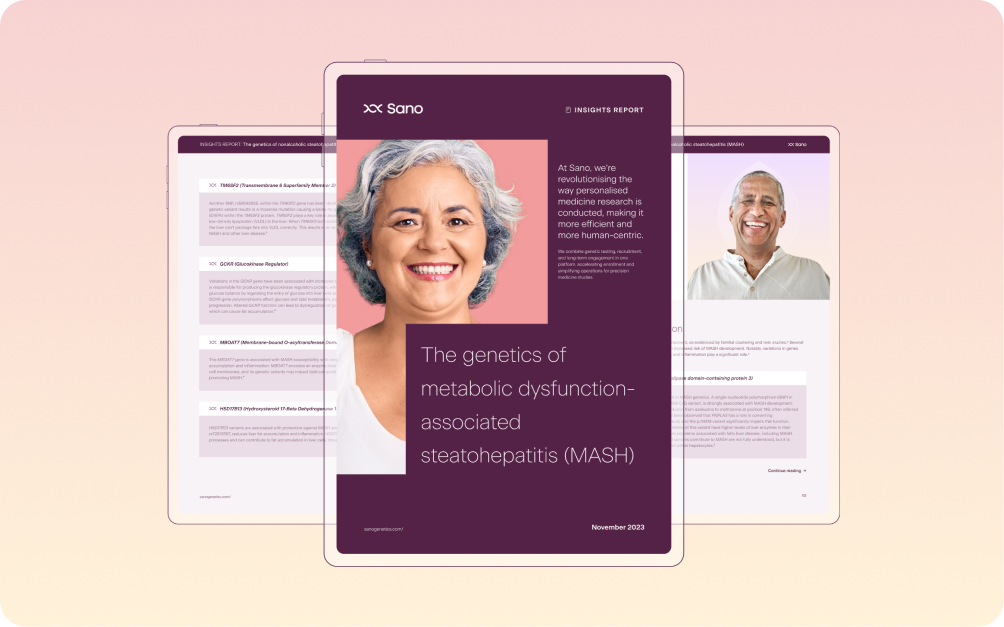
MASH (Metabolic dysfunction-associated steatohepatitis) is a chronic liver disease that has gained significant attention from the pharmaceutical industry and clinical societies in the last decade. In this webinar, Dimitar Tonev, a trained hepatologist and an expert in chronic liver diseases, chatted with Patrick Short, CEO of Sano Genetics, to provide insights into the challenges and opportunities in developing drugs for MASH.
This webinar was hosted by Paul Wicks and featured Sano CEO Patrick Short, Rakhi Rajani from Genomics England, and Julian Hastings Ward who chairs the participant panel for Genomics England.
This webinar, hosted by Patrick Short, CEO of Sano Genetics, and featuring Dr. Mark Kotter, CEO of bit.bio, focused on precision medicine in multiple sclerosis. The conversation ranged from stem cells and the effect they can have on neurodegenerative disease like multiple sclerosis to the future of synthetic biology.