blog-icon

Clinical research blog

Explore our blog for insights into the big questions in precision medicine and clinical research.

New frontiers in rare disease research

In the ever-evolving field of rare disease research, it's crucial to remain informed about the latest progress. At Sano, our commitment is to stay ahead of these developments. We are excited to offer a curated overview of some of the most significant advancements in rare disease research from the past few months.

Continue reading

Decoding health: How AI transforms genomic medicine

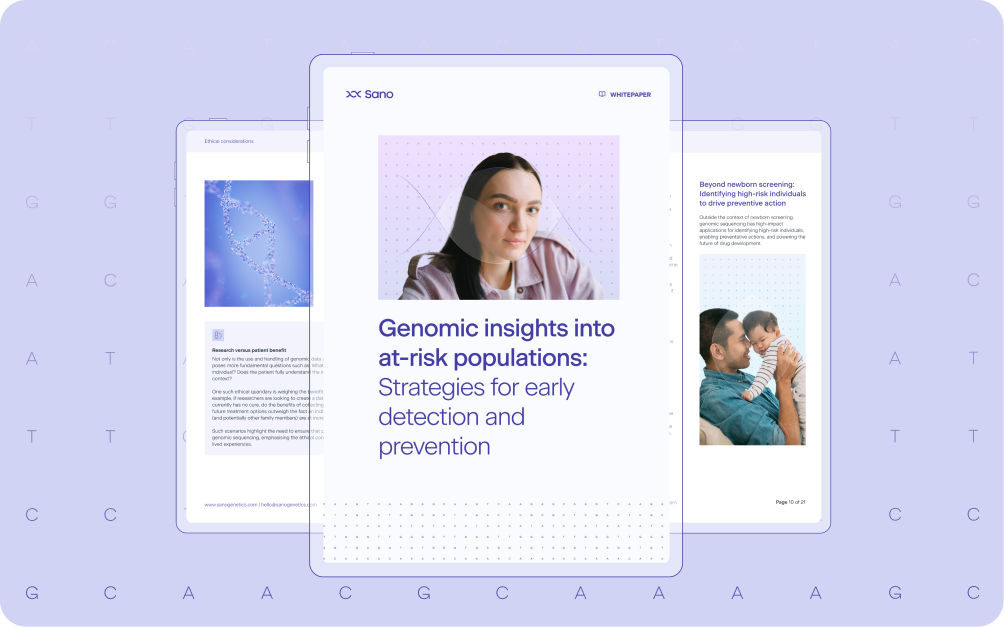
In the rapidly evolving world of healthcare, a profound transformation is taking place at the intersection of Artificial Intelligence (AI) and genomics. This convergence is not just a fleeting trend; it's a fundamental shift in how we approach medicine, diagnosis, and treatment. Our latest whitepaper explores this significant development, shedding light on how AI is unlocking new possibilities in genomic medicine.

Continue reading

Taking charge: How precision medicine is transforming patient engagement

Since the advent of precision medicine, there has been a noticeable shift in patient engagement and decision-making in healthcare. Patients are now more vocal and proactive, expressing a strong desire to be actively involved in their healthcare journey. This engagement reflects an increased awareness and understanding of their health needs and options, aligning with the personalised nature of precision medicine. In this blog, we examine precision medicine’s role in empowering patients to be more involved in their healthcare decisions, then explore how this shift is shaping the dynamics between healthcare providers and their patients.

Continue reading

Key strategies for patient-centric communication in precision medicine: An essential checklist

In the rapidly evolving field of precision medicine, the role of patient engagement and communication is pivotal. As we venture into this new era of personalised healthcare, it's essential for pharmaceutical and biotech companies to establish trust and transparency with patients. This checklist serves as a guide to ensure companies are taking the right steps to effectively engage and communicate with patients participating in precision medicine research.

Continue reading

Natural history studies in the era of AI

Natural history studies play a pivotal role in understanding how diseases develop and progress over time. These observational studies track disease trajectories without experimental intervention and are particularly important in rare disease research, where existing data is often limited. They serve as fundamental benchmarks against which the effectiveness of new treatments can be measured. Over the course of a study, extensive data is collected, including initial diagnosis, clinical observations, treatment history, and patient-reported outcomes on quality of life. This longitudinal data provides the foundation for understanding disease progression, identifying meaningful endpoints, and informing the design of future clinical trials.

Continue reading

Valuable insights and expert connections: A recap of NASH-TAG

Last week, we attended the NASH-TAG conference in beautiful Park City, Utah. Against a winter wonderland backdrop, we dove deep into the latest research on metabolic associated steatohepatitis (MASH, also known as non-alcoholic steatohepatitis or NASH) and connected with leading experts in the field. Here, we’ll share some of our key learnings, underscoring the evolving landscape of liver disease research. 

Continue reading

Strategic data sharing in precision medicine: A checklist for biotech and pharma

In the ever-changing field of precision medicine, continuous evaluation of data sharing and collaboration practices is essential for biotech and pharma companies. This ongoing assessment is vital to ensure compliance with evolving regulations, protect patient privacy, and foster innovative research. Drawing from our expertise in this area, we've created a straightforward checklist to help these companies responsibly handle genetic and biomarker data and collaborate effectively with third parties.

Continue reading

AI drug discovery in pharma: Partnerships and pitfalls

Drug development remains one of the most complex, costly, and failure-prone processes in the life sciences. Traditional approaches rely heavily on trial-and-error experimentation, sequential decision-making, and fragmented data. The emergence of AI, including large language models and generative AI, is beginning to reshape this process, not by replacing human expertise, but by augmenting it across the entire development workflow, from target identification through post-market surveillance.

Continue reading

A precision medicine year in review

As the new year unfolds, it's a time for reflection on some of the most inspirational stories in human genetics last year, and anticipation of what's to come in this area in 2024.

Continue reading

The DNA divide: Exploring the importance of genomic literacy

In the two decades since the first human genome sequencing, technological progress has unlocked an enormous collection of genetic data. This invaluable resource has deepened our understanding of DNA's role in diseases and the diverse genetic makeup among individuals. However, a significant caveat exists: a disproportionate amount of this data stems from individuals of European descent. As of 2021, over 86% of genomic data hails from this group, with East Asians contributing around 6%, Africans 1%, and all other demographics less than 1%. This skew in data collection limits the potential benefits of genomic research for underrepresented populations. And one issue at the heart of it is a lack of genomic literacy. 

Continue reading