 By Ben Jackson
When a clinical trial misses its enrollment targets, the instinct is often to look at recruitment through more channels, more outreach, and a bigger advertising budget. That response can be useful when the funnel is working as intended. In genetically stratified rare disease trials, however, enrollment pressure is often shaped by decisions made much earlier, including protocol design, access to genetic confirmation, site workflows, consent experience, and the participant journey.
Screen failure, the point at which a participant who has expressed interest is found to be ineligible or drops out before enrollment, is one of the most expensive and disruptive challenges in clinical development. In precision medicine, it is also one of the clearest signals that the trial design may not fully reflect how eligible patients are found, confirmed, and supported through enrollment.
Sano-supported rare disease programs show that one of the most important fracture points comes after eligibility confirmation. Participants may be interested, screened, and eligible, yet still fail to convert into active testing. That gap is where better design can have a measurable impact: helping eligible participants move from interest to action with less uncertainty, delay, and friction.
The scale of the problem
Across the clinical trial industry, approximately 85% of trials fail to recruit enough patients and 80% are delayed due to recruitment problems. A 2023 analysis of over 2,500 randomized clinical trials found that only around one in five were completed within the planned timeframe, with a median delay of more than 12 months. Given that the average daily cost of running a Phase III trial is estimated at around $55,000, those delays translate directly into tens of millions of dollars in lost time.
Screen failures are a major driver of this. In genetically stratified programs targeting rare variants, where patients may need molecular confirmation before being deemed eligible, rates can be even higher. Each screen failure represents a person who engaged with the trial, often underwent some form of screening or testing, and then did not enroll.
In rare disease, that loss has additional significance. Eligible populations are small, diagnosis is often delayed, and patients who disengage can be difficult to re-engage. Every avoidable screen failure can reduce confidence in feasibility, extend timelines, increase costs, and weaken the path to enrollment.
Where the funnel actually breaks
Data from rare disease trials supported by Sano Genetics shows that one of the most important fracture points comes after eligibility confirmation. The issue is not only whether sponsors can attract interested participants. It is whether eligible participants convert into active testing.
Across studies, 98% of participants who sign up begin the onboarding flow. Around 74% complete onboarding. Eligibility rates among those who complete onboarding are high, ranging from 82% to 98%.
At this point, the funnel appears to be working well. Participants are engaging, completing initial steps, and being identified as eligible.
The critical variation comes immediately after eligibility confirmation. Across studies, the proportion of eligible participants who order a genetic testing kit ranges from just 28% to 97%. Once kits are ordered, completion rates are consistently high, ranging from 72% to 96%.
The fragile point is the transition from passive eligibility to active participation. The next step requires action, commitment, and trust. When the participant journey does not support that transition, sponsors can lose people who may have been exactly the patients the trial needed to reach.
For precision medicine sponsors, this changes the enrollment question. The issue is not simply how to generate more interest. The more important question is how an eligible participant finds the trial, understands the process, completes genetic confirmation, and reaches enrollment without losing momentum.
Recruitment challenges are locked in at protocol
In a Rare Disease Day 2026 webinar hosted by Sano Genetics, Lindsey Wahlstrom, a patient engagement expert and the founder of Rona’s FunLab, offered a perspective that cuts to the heart of the issue.
"I hold this to be true: recruitment challenges are locked in at the moment of protocol lock. And so if you are not engaging families prior to that point, I think you might struggle with recruitment. It's not a marketing thing. It's a design thing."
This point is especially important in precision medicine. By the time a trial opens, many of the decisions that determine whether eligible patients can be identified, screened, genetically confirmed, and enrolled have already been made.
Eligibility criteria may require confirmatory genetic testing that many patients have never received. Visit schedules may assume proximity to specialist centers. Consent materials may satisfy regulatory requirements while doing little to help participants understand what will happen next. Site workflows may depend on clinicians identifying patients opportunistically, without the training, tools, or pathways needed to make that practical.
All of these choices affect screen failure before the first recruitment campaign goes live.
The genetic testing step is a critical conversion point
In precision medicine trials, the genetic testing step is one of the points where the participant journey becomes more demanding.
A participant may be willing to answer screening questions, read study information, or complete onboarding. Ordering a kit, collecting a sample, returning it, and waiting for results introduces more friction. It also introduces uncertainty. Participants may have questions about what the test is for, what results they will receive, how their data will be used, and what the implications could be for them or their family.
The Sano funnel data suggests that this step deserves more attention in trial design. When eligible participants do not order kits, the issue is often not lack of interest. It is a failure to convert interest into action at the exact moment when the trial asks the participant to take a more concrete step.
That conversion depends on the design of the testing pathway. At-home testing options, clear instructions, timely follow-up, genetic counseling access, transparent communication about results, and simple logistics can all determine whether an eligible participant continues or drops out.
This is particularly important in rare disease. Patient identification challenges are amplified by uneven use of genetic testing across healthcare settings. Many patients with rare diseases have never had confirmatory molecular testing. A protocol that depends on genetic confirmation needs an accessible route to that confirmation. Otherwise, the trial can exclude or lose the very patients it was designed to serve.
When those elements are in place, participant progression can change significantly. In genetically stratified Parkinson's disease programs supported by Sano, early engagement combined with streamlined genetic testing enabled rapid identification of eligible participants within weeks of campaign launch. High completion rates at the testing stage helped patients progress efficiently through the funnel once they had committed to testing.
Site workflows can reduce or amplify screen failure
Screen failure is also shaped by where eligible patients are and how the trial expects them to enter the study.
Specialist centers with the capacity to run complex genetic trials are unevenly distributed. Patients outside major academic hubs may qualify clinically and genetically while still facing practical barriers that make participation difficult. For sites, patient identification can also be hard to operationalize when it sits outside routine workflows.
In a Phase 2 Parkinson's disease trial targeting a specific genetic variant, Sano Genetics developed a strategy that embedded patient identification into routine clinical workflows at activated sites. Sites received structured onboarding and training, ongoing operational support, and referral pathways aligned with how they already worked.
As a result, demand for genetic testing exceeded initial projections, leading to a doubling of planned testing kits from 600 to 1,200. The mutation hit rate held at approximately 30%, validating the quality of identification. In addition, 44% of randomized patients to date originated from activated trial sites, indicating that site enablement as a deliberate design element nearly doubled the rate of randomizations compared to patient advertising alone.
Genetic testing kits were also made available at sites during routine visits. This removed a common delay between clinical conversation and participant action. When a patient had just discussed the study with a clinician, the next step was immediately available.
For precision medicine trials, site enablement should be treated as part of trial design. Training, workflow integration, kit availability, and clear referral routes can all reduce attrition at the moments when patients are most likely to lose momentum.
Precision patient finding improves the quality of the funnel
The concept of precision patient finding is often framed in terms of speed and cost. Sponsors want to find the right patients faster and reduce the cost per enrolled participant. Both are real benefits. Precision patient finding also functions as a screen failure reduction strategy because it changes who enters the funnel in the first place.
Traditional recruitment approaches often emphasize the number of patients reached, screened, or tested. In precision medicine, those metrics can be misleading when large numbers of patients enter the funnel with a low probability of meeting genetic and clinical criteria.
A better measure is the proportion of participants who remain eligible after genetic and clinical validation. Outreach strategies that incorporate genetic profiling, electronic health record data, patient registries, advocacy partnerships, and existing datasets can increase the likelihood that people entering the funnel are genuinely relevant for the study.
Comprehensive genomic profiling is one example of this design logic. A single comprehensive profile can identify potential eligibility across multiple studies, rather than requiring a new single-variant test for each trial. For sponsors running more than one program, this approach can reduce per-patient screening costs while shortening timelines by enabling identification against existing genetic data.
The goal is to reduce avoidable attrition by improving the match between the trial, the patient population, and the pathway into enrollment.
Consent is a participant journey decision
Consent is often framed as a regulatory milestone. In practice, it is also a conversion point.
Data from Sano-supported programs shows that participants who complete onboarding and consent are more likely to continue. Drop-off rates decrease significantly after consent, suggesting that this step can deepen participant commitment when it is designed well.
For participants and families, consent is where the study becomes more real. They need to understand why the study matters, what will happen next, what participation involves, how risks and benefits should be interpreted, and how their contribution connects to the broader research goal.
As Lindsey mentioned in the webinar:
"Informed consent becomes less about explaining the risks and the benefits and more about really helping families understand what's coming at them."
Risks and benefits matter, of course – but regulatory completeness alone is not enough. Consent also needs to help participants and families understand what participation will mean in practice. Consent materials that are dense, jargon-heavy, or disconnected from the participant’s lived experience can weaken engagement. Consent designed around clarity, relevance, and next steps can support the transition from interest to action.
Designing for conversion quality
Precision medicine sponsors need to evaluate recruitment performance through the full participant journey, not just through top-of-funnel activity. A high volume of interested patients has limited value if eligible participants fail to convert into testing, referral, and enrollment.
The Sano funnel data shows why this matters. Across rare disease programs, many participants who sign up begin onboarding, many complete it, and a high proportion of those who complete onboarding are eligible. The major variation comes after eligibility confirmation, when participants are asked to order and complete genetic testing.
That is the point sponsors should design around.
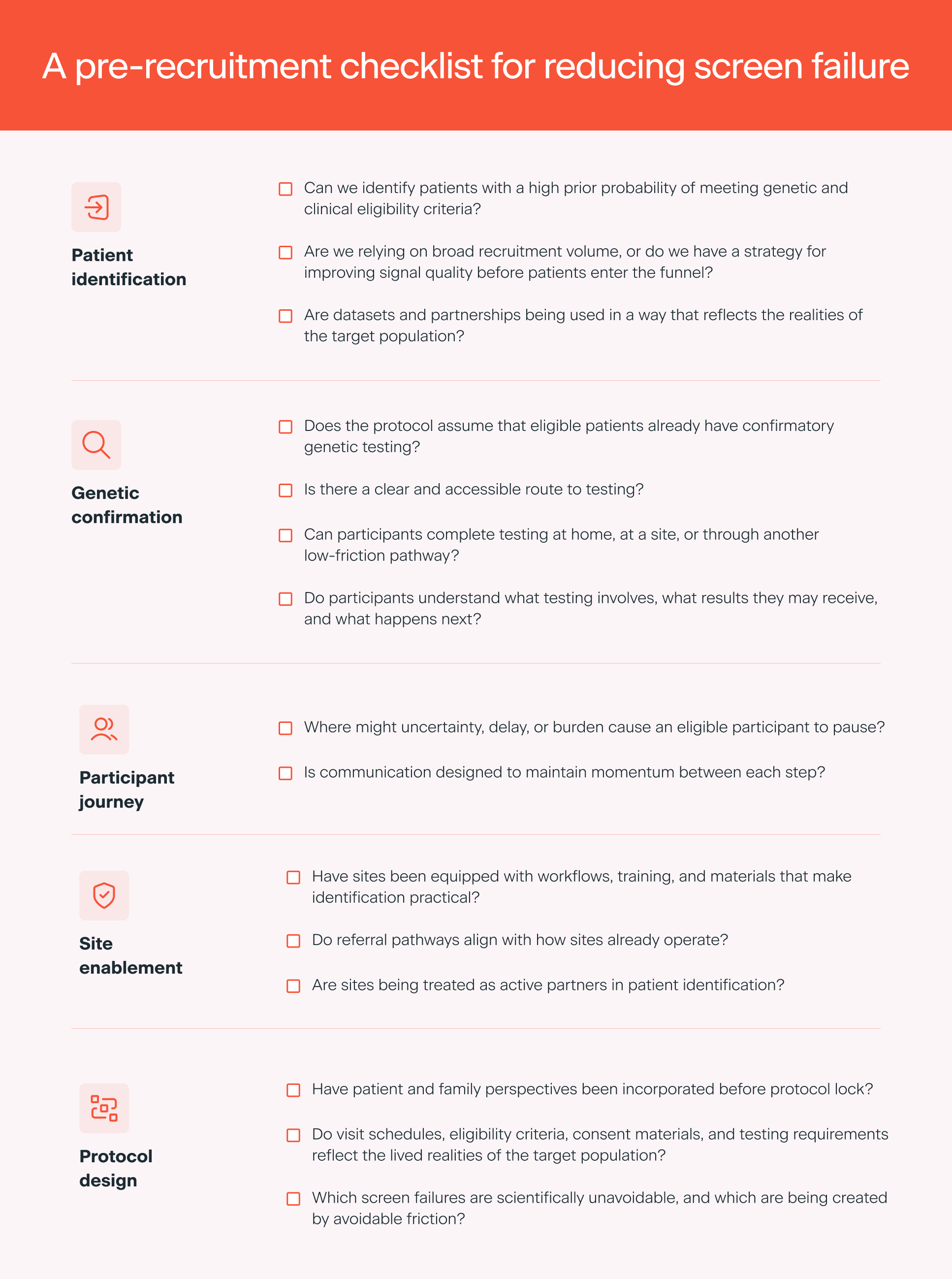
Better genetic confirmation pathways, clearer participant communication, site-enabled workflows, and earlier patient input can all reduce avoidable attrition. These levers need to be considered before recruitment begins, because they are shaped by protocol design, operational planning, and the infrastructure built around the study.
The sponsors who recruit faster and retain more effectively will be the ones that treat enrollment as a design outcome. They will ask earlier how an eligible patient will find the trial, understand it, complete testing, reach the right site, and move through each step with enough confidence to continue.
Sano Genetics supports precision medicine sponsors across the full participant journey, from patient identification and genetic testing through to site enablement and long-term engagement. To learn more about how Sano can help reduce screen failure in your program, get in touch.