Clinical research blog
Explore our blog for insights into the big questions in precision medicine and clinical research.
Genetics is reshaping the landscape of clinical research, and our latest whitepaper, "Guide: Genetics Essentials for Clinical Research Professionals," offers a concise yet comprehensive overview of this rapidly evolving field. This guide explores genetics' crucial role in drug development, discovery, and patient care.
Precision medicine marks a shift from the one-size-fits-all approach to healthcare to tailored treatments and interventions that account for an individual's unique genetic makeup, lifestyle, and environment. Precision medicine improves patient outcomes and reduces the risk of trial failures by targeting treatments to individuals with the highest likelihood of response. But its validity depends on the participation of diverse and representative populations in research. Diversity ensures that medical insights are applicable across a wide range of individuals, preventing biased results that may favor specific ethnic or demographic groups.
In this webinar, Patrick Short, CEO of Sano Genetics, discussed opportunities to improve clinical trial patient recruitment in decentralised clinical trials (DCT) with Joss Warren, the Vice President of Strategic Accounts at THREAD Research. Their discussion covered how DCTs are changing the clinical research landscape, and what they mean for diversity in clinical trials as well as the future of precision medicine.
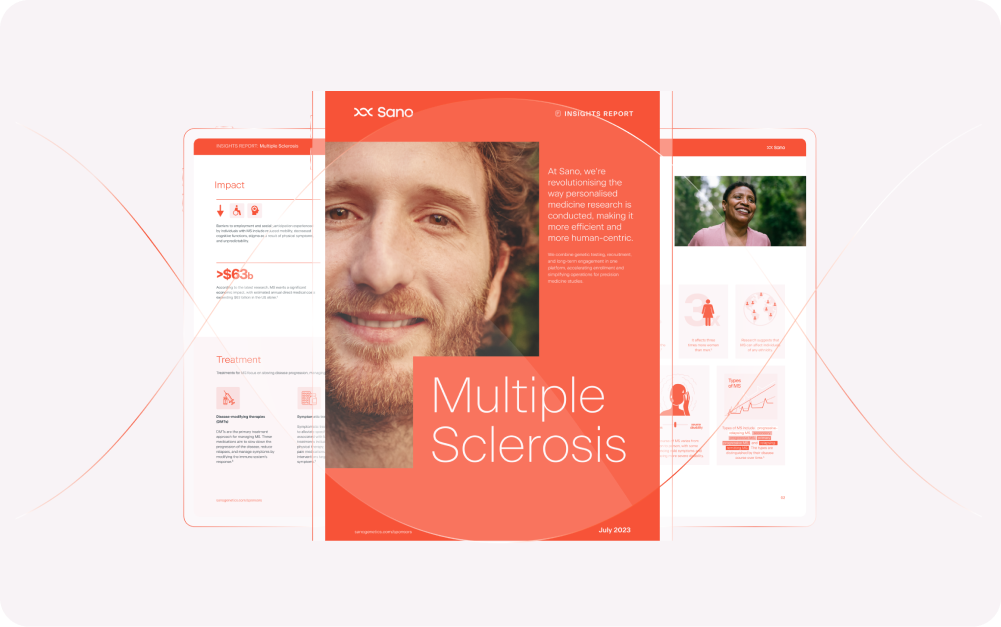
Our latest insights report explores multiple sclerosis (MS), providing details on the essential aspects of MS, from its impact on the central nervous system to the varying types of the condition. We share insights on:
In this webinar, Sano co-founder and CEO Patrick Short discusses the essentials of genetics and genomics, including genetic variation, genetic testing, and more. Patrick offers a thorough overview of current discoveries and discusses how they may impact the future of clinical practice.
Rare diseases may impact a small portion of the population, yet their significance is profound. And while rare disease patient recruitment might seem similar to recruitment for more prevalent conditions, it's a puzzle of its own. Conditions affecting a fraction of the population present complex obstacles. From the intricate challenge of participant scarcity, where the rarity of these conditions presents a unique hurdle, to the multi-faceted complexities of engagement, the world of rare disease trials demands innovative strategies that reframe the way we approach research.
Genetics has become a defining factor in how clinical trials are designed, who qualifies, and how enrollment is planned. Genetic variation influences both disease development and treatment response, which means that recruiting, screening, and selecting participants for genetically stratified trials requires a fundamentally different approach to enrollment planning.
Last month, our team had the pleasure of attending the European Network to Cure ALS (ENCALS) meeting, an annual gathering that brings together some of the brightest minds in the field of amyotrophic lateral sclerosis (ALS) research and treatment. Each year, the ENCALS meeting reaffirms the commitment of the scientific community to ending ALS and brings renewed hope to patients and their families. While our team enjoyed networking with attendees and catching up on the latest research in ALS, this year they were also focused on Sano’s poster presentation for an initiative we are calling Light the Way.
£330K grant awarded to support and engage patients at risk of MND/ALS, and track the psychological impact of genetic testing.
This webinar, featuring Sano Genetics team members Ross Rounsevell and George Bowley, highlights the importance of purposeful participant engagement in research studies. The discussion centres around meaningful research participant engagement, its significance in research, strategies for effective engagement, and the future developments enabling better study design.