
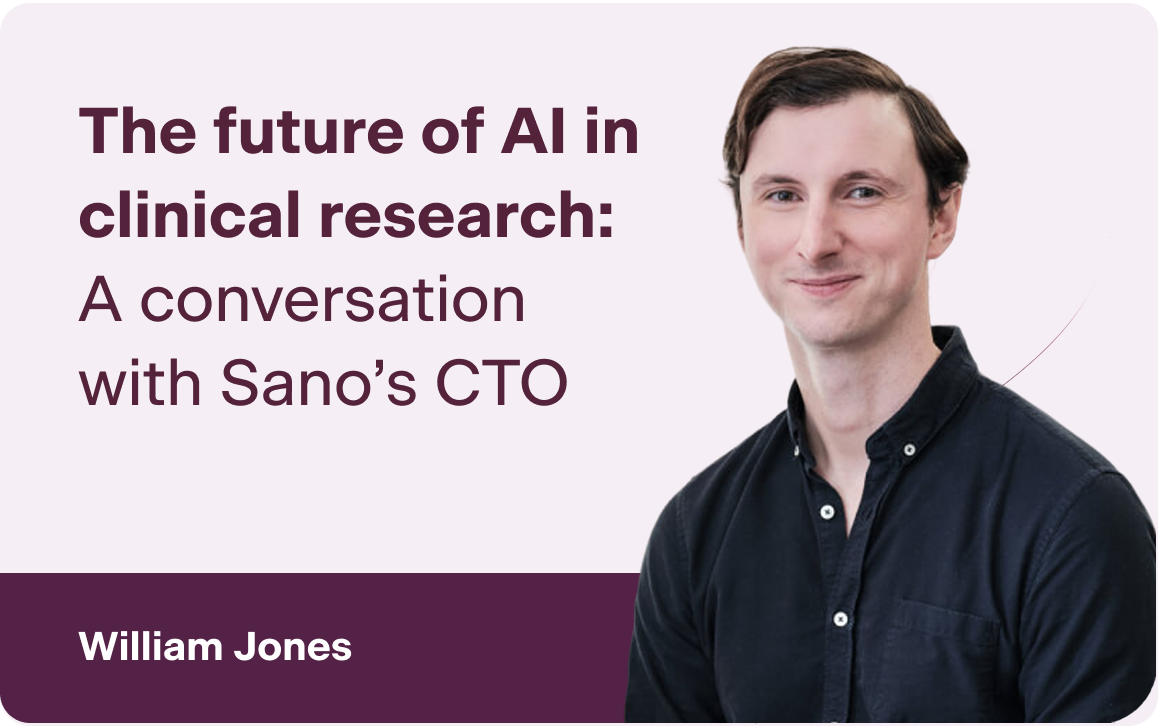
The future of AI in clinical research: A conversation with Sano’s CTO
 By Charlotte Guzzo
At Sano Genetics, our mission is to deliver and facilitate clinical trials that accelerate the development of precision medicine treatments for patients. As a company rooted in data, analytics, and software, we are constantly attuned to technological advancements that can make our work faster, more effective, and more impactful. This mindset drives us to continuously explore and adopt tools that improve operational efficiency and empower our team to work more productively.
One of the most transformative of these tools is artificial intelligence (AI). In this conversation, we sit down with William Jones, Sano’s Chief Technology Officer, to explore how AI is reshaping the way we build products, design clinical trial experiences, and support innovation across the company.
From internal strategy to product integration
Q: How would you describe Sano’s overall philosophy around using AI today, both on the internal front and on the customer front?
“Up until now, our focus was on determining the most effective AI strategies internally, particularly what works for our unique business and our space. Today, we’re entering a new phase of integrating AI into our core product. That means putting powerful AI tools into the hands of our administrative users first, and eventually, trial participants themselves. We’re doing this under clearly and thoughtfully defined use cases.”
This shift reflects Sano’s commitment to making AI not just an internal asset, but an integral part of the value delivered to customers and participants. It is important to note that these usage cases do not entail AI handling any patient information or other sensitive data. Furthermore, trial sponsors and participants must be aware of and consent to the use of AI in the given context.
Why we’re investing in AI now
Q: What motivated the engineering team to begin embedding AI across the product pipeline over the past year?
“The ‘magic’ experiences AI makes possible are just too compelling to ignore. Some things that felt impossible when we started Sano are now entirely achievable. We can finally reimagine what a perfect, frictionless experience looks like for a clinical trial participant. We’re now establishing the foundations to begin building towards that.”
By embedding AI into everyday workflows, the team is unlocking entirely new product capabilities and rethinking user experiences from the ground up.
Transforming the trial setup pipeline
Q: What AI capabilities are now baked into our trial setup workflows that weren’t there 12 months ago?
“We use AI throughout the setup pipeline to make the process much faster and more efficient. We use it to extract study steps from existing protocols, translate copy into multiple languages, and review it for IRB suitability. We quality check output at every stage.”
Q: Can you walk us through a recent example or pilot where AI measurably improved trial setup speed or participant targeting?
“We recently built a ‘Sano Agent’ that can go from raw study protocol to a fully built study in minutes. It literally assembles each component of the study live on our platform, piece by piece, right in front of your eyes.”
This automation compresses a previously slow and manual process that could take days into just a few minutes, enabling faster trial launches without sacrificing quality or compliance. It’s particularly useful for scaling trials to new regions or groups of participants. Rather than establishing the study from scratch, these automations make it possible to use an existing study to draft various components of the new study, such as eligibility questionnaires, within minutes.
How AI has changed the way engineers build
Q: How has the integration of AI tools changed the way engineers at Sano build and deploy features?
“It’s been a big shift. We’ve embraced AI tools company-wide because we believe this is the future of software development.”
A recent example illustrates just how powerful that shift can be. Will described the development of the Flow Mapper, a visual canvas that improves upon Sano’s existing Flow Builder for clinical trial participant flows.
“Over a week, and with another week of code review, I used Cursor and Claude 4 Sonnet to develop a new canvas layer. It leveraged the structure of our existing Study Mapper tool. This turned out to be a resounding success, and it’s now live in production.”
Building a culture that embraces AI
Q: What were some of the most significant cultural or structural changes you made to enable teams to work effectively with AI?
“Very early on, we gave the whole company access to ChatGPT, and we frequently share examples of how we’re using it. These tools are so new that a single insight from one person can save someone else countless hours. That kind of cross-team knowledge-sharing has been key to accelerating AI adoption. It’s not enough to have the tools, you need the culture and curiosity to get the most out of them.”
Navigating friction and finding product-market fit
Q: What does successful AI integration look like and are there any bottlenecks or pain points that are still causing friction?
“There are still a tremendous number of bottlenecks. The biggest one is figuring out what the customer actually needs. You can build something incredibly fast, but if it doesn’t solve a real problem, it’s useless.”
“As more code is produced by AI, the rate-limiting step becomes how fast engineers can comprehend it and run meaningful tests. That’s why fast, reliable continuous integration (CI) is critical. When the AI got stuck, I had to dig into the code to find the problem. As soon as I pointed it out, the AI fixed it instantly. But that human diagnosis still mattered.”
Next steps
Q: What does the future of AI in clinical research look like to you in the next 1–2 years, and what role will Sano play?
“I think participants will soon be able to interact with AI agents through voice, or we might use AI to scan all of someone’s medical records and only ask them the questions we don’t already have answers to. That would be a huge leap forward in participant experience and efficiency.”
Where AI does not belong
Q: Are there any facets of Sano’s processes and product that you believe are not suitable for AI integration?
“There are definitely areas where AI doesn’t belong. Human connection and the human touch will always be crucial. I truly believe that robots aren’t taking our jobs, we’ve just been doing robots’ jobs. As tools get smarter, our work will evolve. But the heart of medical research will always be humans finding treatments for human disease. The tools change, but the mission stays the same.”