
Podcast recap: Vincent Dion on hijacking DNA repair machinery to treat Huntington's disease
 By Joy N. Ismail, PhD
More than three decades after the Huntington's disease gene was cloned in 1993, there is still no approved therapy that alters the course of the disease. Recent high-profile setbacks have underscored a difficult reality: silencing or lowering the mutant huntingtin protein may not be enough. The underlying genetic instability that drives disease progression remains unaddressed.
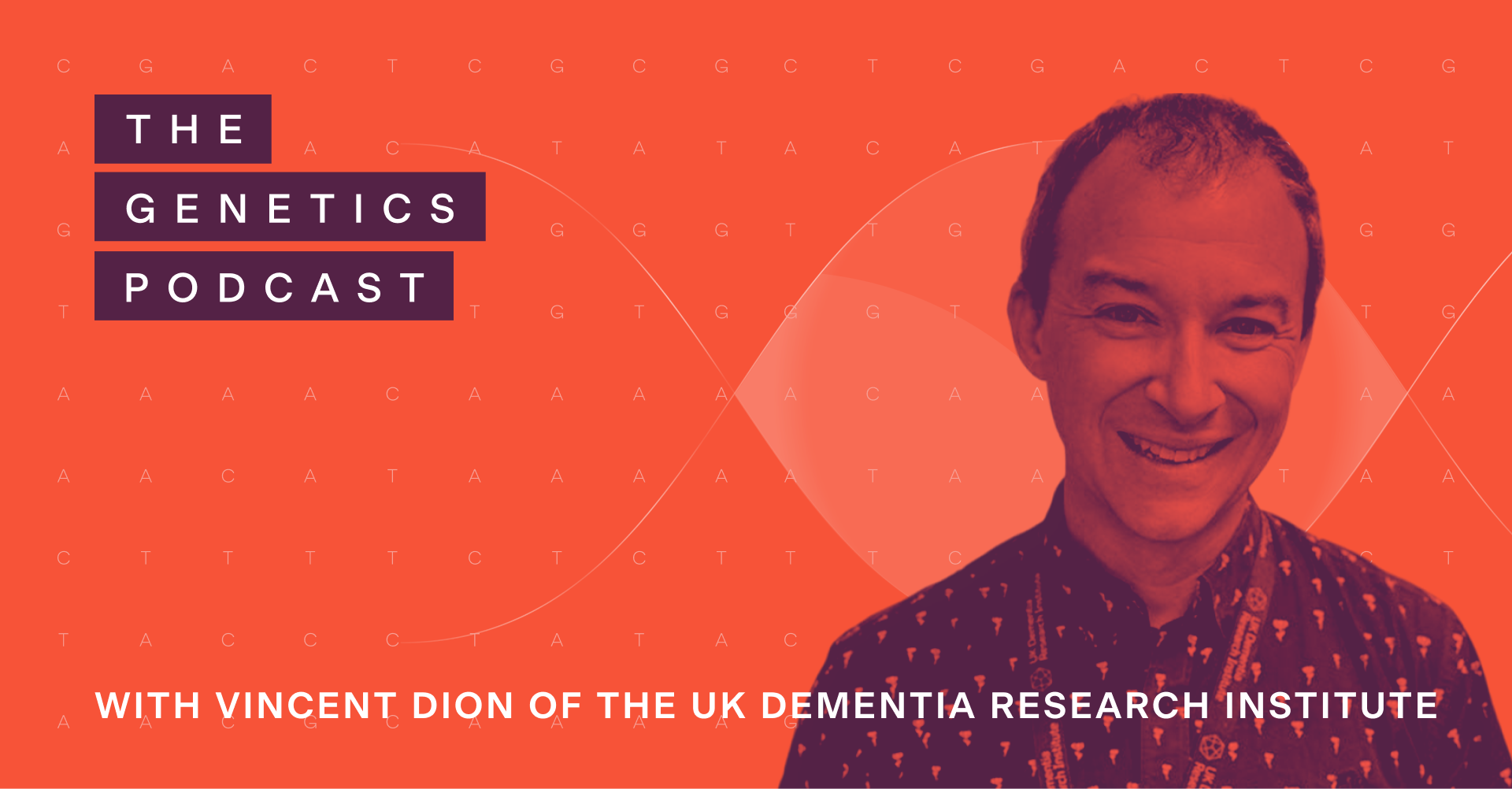
In the most recent episode of The Genetics Podcast, host Patrick Short speaks with Dr. Vincent Dion, Group Leader at the UK Dementia Research Institute at Cardiff University, about a fundamentally different approach. Vincent's lab has shown that CRISPR nickase editing can contract the toxic CAG repeat expansions responsible for Huntington's, a finding that emerged from basic research into how DNA repair machinery behaves on repetitive sequences. The conversation traces a path from origins-of-life chemistry to first-in-human trial planning and raises important questions about how the field measures success in the brain.
DNA repair as a disease driver
The conventional understanding of DNA mismatch repair is that it protects the genome against mutations. In Huntington's disease, that assumption breaks down.
Genome-wide association studies published in 2015 and 2019 identified variants in mismatch repair genes as significant modifiers of disease onset. Patients with certain repair gene variants developed symptoms earlier or later than predicted by their CAG repeat length alone. This indicates the repair machinery itself was contributing to disease progression.
As Vincent explains, "DNA repair, which we tend to think of as protecting the genome against mutations, is actually actively making mistakes on this aberrant substrate." In cells carrying expanded CAG repeats, mismatch repair proteins recognize the unusual DNA structure and attempt to fix it. But instead of correcting the error, they add more repeats. Over a patient's lifetime, this somatic expansion drives the CAG tract longer in vulnerable brain cells, accelerating toxicity.
This reframing shifts the therapeutic target. Rather than focusing solely on the protein product of the mutant gene, it opens the possibility of intervening at the DNA level to stop or reverse the expansion itself.
CRISPR nickase as a contraction engine
Vincent's lab discovered that using a CRISPR nickase, which cuts only one strand of the DNA double helix rather than both, reliably causes CAG repeat contractions rather than expansions. The finding was serendipitous, emerging from experiments designed to study basic DNA repair mechanisms rather than to develop a therapy.
The distinction between a nick and a double-strand break is critical. Double-strand breaks trigger error-prone repair pathways that can introduce insertions, deletions, or translocations. A single-strand nick, by contrast, engages a different set of repair processes that, on expanded CAG repeats, tend to shorten the tract.
Vincent's team has demonstrated these contractions in human stem cell-derived neurons and in mouse brain tissue. A key technical breakthrough was cell-type-specific codon optimization of the CRISPR components, with roughly 16% of codons changed to improve expression in the target cell population. This level of engineering specificity reflects how far the approach has moved from a bench observation toward a deliverable therapeutic.
As Vincent puts it, "Nobody really wakes up one morning and says, 'I'm going to now invent a completely new way of editing DNA.'" The path from basic science to translational program was neither planned nor predictable.
The case for correction over silencing
Several therapeutic strategies for Huntington's are currently in development, including gene silencing approaches that aim to reduce production of the mutant huntingtin protein. UniQure's AAV-based gene therapy has shown promise, though the FDA has requested additional data before approval.
Vincent argues that directly contracting the CAG repeat offers a distinct advantage: it is potentially a one-time correction rather than a lifelong treatment. Gene silencing requires sustained delivery and ongoing suppression of protein production. A contraction-based approach, if it works, would address the root genetic lesion and eliminate the need for continuous intervention.
This distinction carries practical implications for clinical development, manufacturing, and long-term patient management. A single intervention that permanently shortens the repeat tract would fundamentally change the treatment paradigm for Huntington's and potentially for other repeat expansion disorders.
Vincent's sense of urgency is clear: "I feel like if I am not pushing this towards translation, it's not that other people will suddenly jump on this." The approach is novel enough that it does not yet have a large community of competing programs driving it forward.
The biomarker gap
One of the most significant challenges facing DNA-targeting therapies for Huntington's is measurement. How do you determine whether a therapy delivered to the brain has actually contracted CAG repeats in the relevant cell populations?
Current biomarkers for Huntington's, such as neurofilament light chain levels in cerebrospinal fluid, measure neuronal damage rather than the underlying genetic change. They can indicate whether neurodegeneration is slowing but cannot directly confirm whether repeats have been shortened in striatal neurons.
This creates a fundamental uncertainty for clinical trials. A therapy could be contracting repeats effectively in the brain, but without a direct readout, investigators must rely on downstream clinical and biomarker endpoints that take years to manifest. Conversely, a negative biomarker signal could reflect measurement limitations rather than therapeutic failure.
The field needs new tools, whether imaging-based, fluid-based, or tissue-based, that can provide more direct evidence of genetic modification in the central nervous system. Until those tools exist, the gap between mechanistic confidence and clinical proof will remain a significant challenge for repeat-targeting programs.
From basic science to first-in-human trials
Vincent's trajectory illustrates the unpredictable path from fundamental research to therapeutic development. His early work focused on origins-of-life chemistry and how repetitive DNA sequences behave during repair. The connection to Huntington's disease emerged gradually, driven by data rather than by a predetermined translational plan.
"The things that haven't worked have not been the things I would've predicted wouldn't work," Vincent reflects. This unpredictability is a recurring theme in early-stage therapeutic development and a reminder that the most impactful programs do not always begin with a clinical endpoint in mind.
His lab is now working toward first-in-human studies, navigating the transition from academic discovery to the regulatory, manufacturing, and clinical infrastructure required to test the approach in patients. It is a path that requires not only scientific rigor but also the operational and strategic capacity to move a novel modality through development.
Listen to the full episode below.