
Podcast recap: Stevie Ringel on building operational capacity for rare disease drug development
 By Joy N. Ismail, PhD
Rare and ultra-rare disease research has produced real scientific breakthroughs over the past decade: antisense oligonucleotides, gene therapies, and gene editing tools that can, in principle, correct the exact genetic cause of a patient's disease. Yet for many patients, these treatments remain theoretical. Understanding why that gap persists, and what it would take to close it, is the focus of this episode.
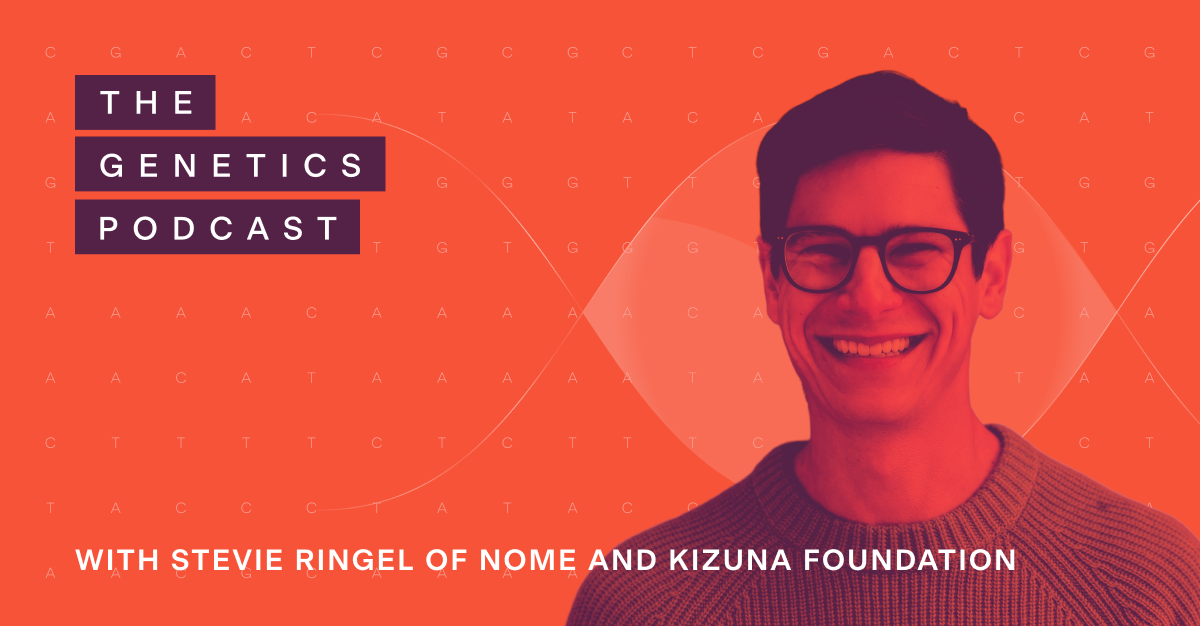
In the most recent episode of The Genetics Podcast, host Patrick Short speaks with Stevie Ringel, Founder and CEO of Nome and Founder of the Kizuna Foundation. Stevie has spent years working on this problem from both the philanthropic and operational sides, and the conversation traces how his view of what actually slows rare disease drug development changed along the way, from an initial focus on funding toward the operational work of running a program day to day.
From diagnosis to founding two organizations
Stevie's interest in rare disease is personal. He was diagnosed at 17 with an inherited retinal disease that causes progressive blindness, and later watched his younger sister receive the same diagnosis. Both carry the KIC founder mutation, which is common in the Ashkenazi Jewish population and affects an estimated 200 patients worldwide, with just 18 known cases in the US.
That experience led him to found the Kizuna Foundation with a straightforward thesis: fund the science, and the medicine will follow. For a time, that thesis held, and foundation-backed research made real scientific progress toward a treatment. The pace of that progress, and what was actually limiting it, prompted Stevie to look more closely at how these programs were run day to day. That inquiry eventually led him to found Nome.
The operational load behind rare disease programs
Stevie eventually concluded that funding was not the main obstacle to progress. “The reason why we're not making faster progress is not due to capital,” he explains. “It's actually due to operational complexity.” Running a rare disease program end to end involves navigating regulatory pathways, coordinating multiple academic labs, managing vendors, and executing manufacturing runs. Each of these is its own specialized function, and each takes time and expertise to manage well.
In a professional biotech company, these functions are typically handled by dedicated regulatory affairs, quality, and program management staff working alongside the scientists. Foundations led by patients and families rarely have that infrastructure. They are often a small group of people managing a research program on top of full-time jobs, fundraising, and advocacy work, which makes the operational side of drug development a much heavier lift than the science itself.
Nome's AI agents for operational capacity
Nome, the company Stevie founded to address that gap, deploys teams of AI agents to support the PhD scientists who manage preclinical programs. “We're talking about how do you use teams of AI agents that can collectively give our team of PhD scientists superpowers in their day-to-day,” he says. By Stevie's estimate, roughly 60% of a program's time goes to day-to-day operational management, and Nome's agents are built to absorb that share of the work, freeing scientists to spend more of their time on the underlying biology.
Nome builds on frontier language models. Stevie frames the company's differentiation as its agent architecture, its evaluation methodology, and a proprietary annotated dataset built up through the company's own program work. On one internal benchmark, Nome's system scores 97% accuracy, compared with 81% for a frontier model used out of the box.
That gap shows up in the scale of what Nome has been able to take on. The company currently runs several preclinical programs and has reviewed roughly 5,000 patient cases in about a year. Every report the system produces is still reviewed by an MD-PhD, a step that takes about 10 to 15 minutes per case, keeping a clinician in the loop on every patient-facing output.
The persistent challenge of delivery
Even with more operational capacity, Stevie is clear that the underlying science is still hard. “Delivery is the hard problem always,” he says. “It has been the last decade, two decades. It will be for the next decade.” Getting a therapeutic molecule into the right cells, whether it is an antisense oligonucleotide, a gene therapy, or a gene editing tool, remains the step that determines whether a treatment works in practice.
Capsid engineering efforts are focused on crossing the blood-brain barrier, a persistent obstacle for neurological disease, while non-viral lipid nanoparticles offer an alternative delivery route for certain tissues. Nome's own work sits downstream of these delivery questions. Its focus is on process excellence within existing tools such as ASOs, gene therapy, and gene editing, supporting programs that use these established modalities.
A capital model built around scale
“The only way costs can come down is through scale,” Stevie says, and that principle shapes how Nome structures its business. The company takes no molecule IP. Foundations and academic partners retain ownership of the science, and Nome provides services around it, positioning itself as shared infrastructure for the field.
Early data from Nome's free reports point to the scale of the underlying problem. Roughly 93% of patients reviewed have no treatment options currently in development. About 25% are strong candidates for an existing programmable medicine, meaning a platform technology, such as an ASO, that could in principle be adapted to their specific mutation without starting drug development from scratch. For that quarter of patients, the constraint is largely the operational work Nome is built to support.
The blizzard behind the company's name
The company's name comes from Nome, Alaska, where in 1925 relay teams of sled dogs carried diphtheria antitoxin through a blizzard to stop an outbreak, a journey now remembered through the story of the lead dog Balto. For Stevie, it's the guiding metaphor for the company's work: “We should not be stymied by the blizzard. We should find a new way to and through the challenges to bring them medicine.”
Key takeaway
Stevie's story points to a specific, addressable problem in rare disease drug development: the operational work of running a program is often the larger obstacle to progress. Nome's bet is that AI agents can take on enough of that operational load, regulatory navigation, vendor management, manufacturing coordination, for PhD scientists to spend more of their time on the science, and for patient-led foundations to run programs that would otherwise require a much larger team. Whether that bet pays off will show up in a fairly concrete number: how many of the roughly 200 patients with the KIC mutation, and others like them across rare disease, end up receiving a treatment that already exists.
Listen to the full episode below.