
Podcast recap: Rachel Salzman on vectorized RNAi for neuromuscular disease
 By Joy N. Ismail, PhD
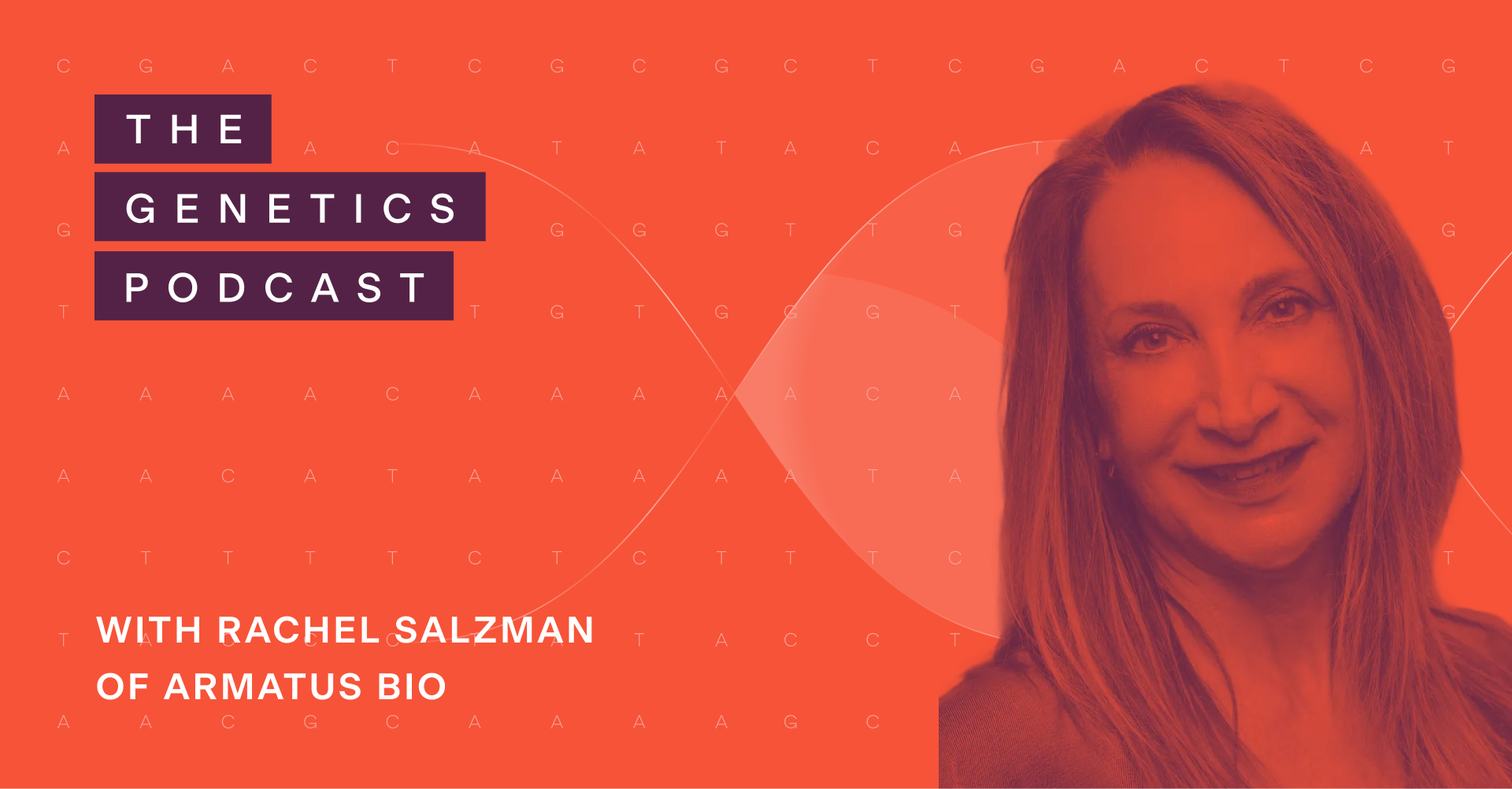
In the last episode of The Genetics Podcast, Patrick spoke with Dr. Rachel Salzman, CEO of Armatus Bio, a biotech company developing vectorized RNA interference (RNAi) for autosomal dominant neuromuscular diseases. The lead programs target facioscapulohumeral muscular dystrophy (FSHD) and Charcot-Marie-Tooth disease type 1A (CMT1A), using AAV to deliver engineered microRNAs for long term silencing of disease genes.
Rachel walked through how vectorized RNAi works, why Armatus focuses on dominant neuromuscular conditions, what it takes to move from strong biology into the clinic and what she has learned from more than 20 years in gene therapy. She also highlighted emerging issues in the field, including the need for higher AAV product purity and new financial models for one-time treatments.
What Armatus Bio does and how vectorized RNAi works
Armatus Bio is a privately held company built around technology licensed from Nationwide Children’s Hospital. The platform combines RNAi and microRNA biology to create synthetic microRNA constructs that are delivered with AAV vectors into target tissues. These constructs are designed to be highly specific to a single disease gene, rather than regulating many genes at once like natural microRNAs.
Once delivered and expressed in the nucleus, the engineered microRNAs use the cell’s existing RNAi machinery to degrade the target mRNA in the cytoplasm and reduce or eliminate expression of the toxic protein. Because AAV deposits the expression cassette into the nucleus and the construct persists in long-lived cells, the goal is a durable effect from a one-time administration, instead of repeated dosing.
Why focus on autosomal dominant neuromuscular diseases
Armatus is currently applying vectorized RNAi to autosomal dominant gain of function diseases where too much of a gene product drives pathology. In these settings, the therapeutic goal is straightforward: silence or significantly reduce the disease gene and move expression back toward a normal range. That is the case for FSHD and CMT1A, the company’s two lead programs.
FSHD affects an estimated 30,000 to 40,000 people in the United States and CMT1A affects roughly twice that. Both have clear genetic causes and high unmet need. Rachel explained that choosing indications with well understood etiology and measurable outcomes is an intentional way to reduce biological and translational risk while the platform matures.
Vectorized RNAi versus “naked” RNAi drugs
Several RNAi medicines are already approved, mostly for liver targets. These are given chronically and rely on delivery approaches that naturally concentrate in hepatocytes. They are powerful, but treatment requires repeat dosing for life, since the oligonucleotides reside in the cytoplasm and are gradually degraded.
Vectorized RNAi aims to extend RNAi to tissues such as muscle and peripheral nerve where chronic systemic delivery is less efficient. AAV acts as a delivery system that is good at infecting cells and placing the cassette in the nucleus. The cell then produces the microRNA over time, in theory enabling long-term gene silencing from a single administration. Armatus is vector agnostic and selects AAV serotypes based on the target tissue and indication.
Progress toward the clinic in FSHD and CMT1A
Armatus is currently in the late preclinical stage. The team has generated proof of concept data in animal models showing that their constructs can knock down the target gene, improve functional measures and support changes in histopathology and biomarkers. These data underpinned pre IND interactions with FDA, where the agency reviewed the scientific rationale and preclinical package.
Both the FSHD and CMT1A programs have received orphan drug designation and rare pediatric disease designation, reflecting the severity and early onset of these conditions. On the CMC side, Armatus has completed process development, analytical methods and a potency assay, and has aligned with FDA on the potency strategy. The remaining work before first in human dosing is scale up manufacturing and standard mouse toxicology studies, supported by existing large animal toxicology and biodistribution data.
Lessons from two decades in gene therapy
Rachel has worked in gene therapy for more than 20 years, beginning with early lentiviral programs for primary immunodeficiencies and ex vivo hematopoietic stem cell approaches. Those efforts cured children with otherwise fatal diseases but also surfaced integration-related leukemias. For Rachel, this period highlighted both the power of the technology and the importance of having the right expertise in the room from the start.
She emphasized two recurring issues. First, early programs often lacked sufficient immunology input, even though many serious adverse events in gene therapy are immune mediated. Second, technical teams sometimes moved ahead without deep enough understanding of the disease community, clinicians, and payers, which affected uptake once therapies reached the market. That experience now shapes how she thinks about indication selection, risk, and patient access at Armatus.
Why AAV product purity matters
Looking across current AAV programs, Rachel is concerned that vector purity has not received enough attention. Many clinical and commercial products contain a substantial fraction of empty or partially filled capsids in each vial. These particles can contribute to immune responses and other side effects without providing therapeutic benefit.
She argues that the field needs more pre-competitive collaboration and transparency on process failures and partial successes, not only on final yields. CDMOs and sponsors generate large amounts of data when runs do not meet purity targets, but these learnings rarely reach the broader community. Regulators such as the FDA see across programs and sometimes hint at better practices, yet most of that information remains confidential. Rachel believes more open sharing would improve safety and build trust.
The need for financial innovation in one time therapies
One-time, potentially durable treatments create fundamental challenges for current pricing and reimbursement models. The manufacturing cost and perceived value of a gene therapy can lead to very high list prices, which in turn cause sticker shock for payers. At the same time, the benefit unfolds over years, while the payment is concentrated at the time of treatment.
Rachel thinks the field needs new financial instruments and payment structures designed specifically for these products, not just incremental tweaks to existing models. She sees an opportunity for people with backgrounds in quantitative finance and health economics to design approaches such as outcomes-based installments, reinsurance structures, or pooled risk mechanisms that align incentives for patients, providers, payers, and developers.
A platform with room to grow
Armatus is starting with FSHD and CMT1A, but the platform is designed to scale. There are hundreds of autosomal dominant monogenic diseases, and a large fraction involve neuromuscular or peripheral nerve pathology. Many have no approved therapies. Vectorized RNAi can, in principle, silence any gene where lowering expression is beneficial, as long as the target tissue is accessible to the chosen vector and the biology is well understood.
Beyond monogenic disorders, Rachel sees potential in targeting nodes in disease pathways, where partial reduction of a gene could improve common conditions such as obesity or metabolic disease. For now, Armatus is focused on executing in FSHD and CMT1A and building a foundation that can support a broader set of indications over time.
Listen to the full episode below.