
Podcast recap: Patrick Short on why verification speed will decide how fast AI transforms biology
 By Joy N. Ismail, PhD
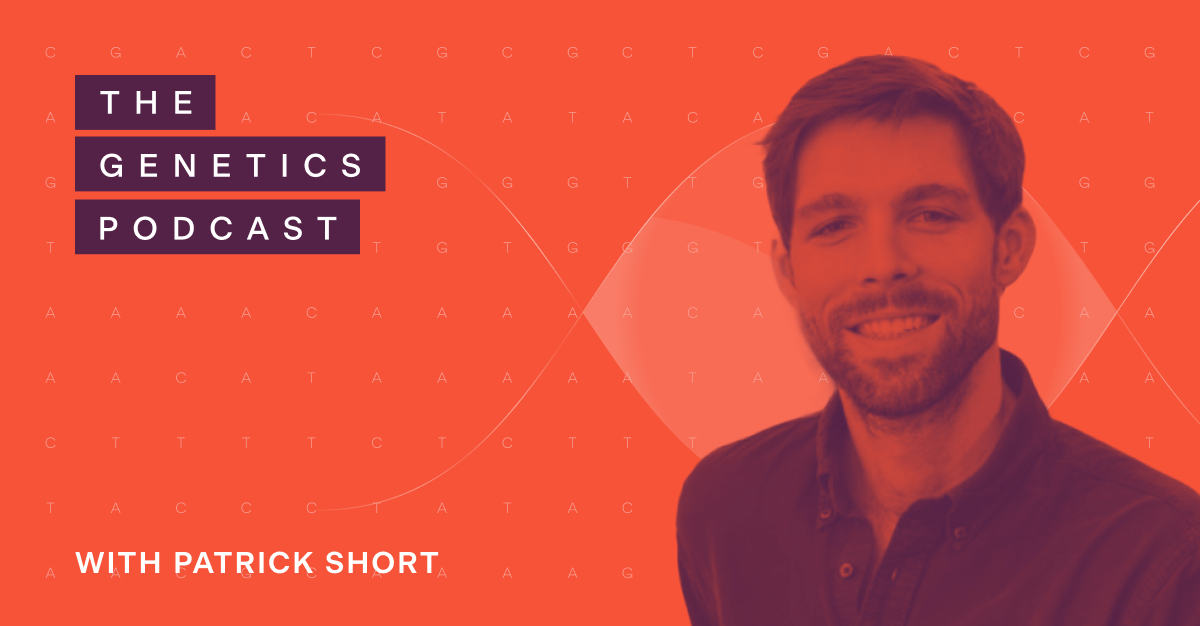
AI systems have started producing results on open problems in mathematics, and mathematicians are paying attention. In the most recent episode of The Genetics Podcast, a solo episode, host Patrick Short asks what those results mean for drug development and genetics.
Patrick is CEO and co-founder of Sano Genetics, and has a PhD in population genomics and the genetic causes of rare disease. His argument is that AI will move in biology only as fast as we can verify its ideas. The largest under-invested opportunity, in his view, is validated surrogate endpoints that act as biology's proof checker.
Fast verification explains AI's progress in math
Patrick starts with recent developments in AI, particularly in math. AI disproved the Erdős unit distance conjecture. OpenAI's claimed Navier-Stokes solution used 10,000 agents over several days, reportedly at a cost of millions of dollars.
The Clay Mathematics Institute has not yet confirmed that result. If it holds, it would be the second of seven Millennium Prize problems solved.
The results also came in volume. Work on more than 4,000 open problems has produced over 700 preprints.
About 160 come with proofs verified in Lean, a proof checker, at roughly three hours each. Humans still picked the problems, and the Navier-Stokes strategy built on earlier human work by Martinez-Oroa and Cordoba.
Lean is what makes the loop fast. It confirms whether a proof is correct almost instantly, and every verified result becomes a building block that later proofs can rely on.
Biology meets two of the four conditions
Patrick identifies four conditions behind AI's progress in math: a clearly defined problem, a capable model, fast verification, and composability. Composability means proven lemmas stack into larger results. Biology has the first two: clearly defined problems and capable models.
The gap is verification. His test for where AI will accelerate biology first is simple:
"Wherever you can close the gap between, 'I have an idea,' and then, 'I've checked and verified that it works the fastest,' that is going to allow these systems to hill climb very quickly."
Composability is weaker in biology too. There are "near lemmas," such as Hardy-Weinberg and the causal link between LDL cholesterol and coronary heart disease.
HDL is the cautionary tale. Genetics and many failed trials showed "good cholesterol" was not causal, and teams that treated it as ground truth spent years chasing it.
Biology's feedback loops run at very different speeds
Patrick lays out a ladder of feedback loops, ordered by how quickly an idea can be checked. On the fastest rung, algorithms are scored against benchmarks such as Genome in a Bottle. He cautions that a benchmark is not the same thing as a clinically useful score, and polygenic risk scores underperform in people of non-European ancestry.
Lab automation shortens the next rungs. In 2018, investigators used saturation genome editing to test around 4,000 BRCA1 variants. AI-driven antibody and binder design, including work from David Baker's lab, also runs on fast experimental loops.
Clinical rungs are slower. Liver targets can show an LDL readout in Phase 1, and Biogen's ATLAS trial uses neurofilament light as a trigger in presymptomatic SOD1 ALS carriers. The hardest rung is trials with no surrogate endpoint, such as Alzheimer's prevention, where the only verification is a clinical outcome years away.
Surrogate endpoints could act as biology's Lean
Most major diseases lack strong, validated surrogate endpoints, and Patrick sees that gap as the central constraint on AI in clinical development. LDL cholesterol, neurofilament light in SOD1 ALS, and viral load in HIV show what a strong surrogate looks like.
A validated surrogate lets an early trial predict clinical outcomes, turning a 5 to 10 year feedback loop into a fast one. Patrick also sees AI helping in three adjacent areas: patient selection, drug repurposing to skip ahead to Phase 2, and mining past trial data.
Phase II success rate is the test for upstream investment
Most of the money is going into preclinical work. Lila Sciences, Periodic Labs, and Genentech are building self-driving labs. Eli Lilly and NVIDIA are collaborating on an AI-powered drug discovery lab in South San Francisco, with plans to jointly invest up to $1 billion over five years in research, talent, and computing infrastructure.
He expects the preclinical lab of the future to look a lot like a self-driving car.
Virtual cell models built from perturbation data are another bet, though they are not yet consistently beating state-of-the-art tools. Patrick notes that math looked the same way until results arrived.
Genetics- and omics-driven discovery at insitro, Recursion, and Isomorphic is a third bet. He applies one test to all of them:
"Does all the investment in upstream lab automation really move the needle on Phase II success rate? In a way, that's the wall right now. That is the great filter that nobody has really showed they're able to move at scale."
Implications for clinical development teams
If verification speed sets the pace, then biomarker strategy belongs in early program planning, alongside target selection. A surrogate validated in one program shortens the feedback loop for every program that follows, while a false one, like HDL, compounds risk. Patient selection and past trial data become part of how quickly a program learns.
If you're designing genetically stratified or biomarker-driven trials and would like to know more about how we can help, please get in touch.
Listen to the full episode below.