
Podcast recap: Marleah Dean Kruzel on reframing hereditary cancer uncertainty
 By Joy N. Ismail, PhD
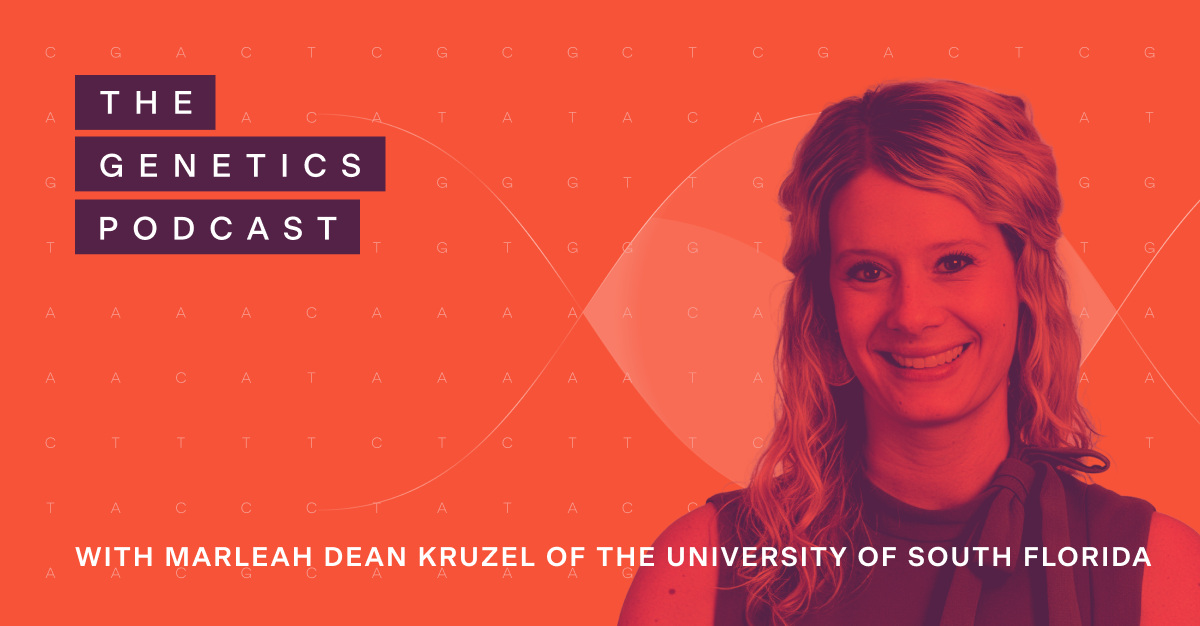
In the latest episode of The Genetics Podcast, Patrick sits down with Dr. Marleah Dean Kruzel, Professor of Communication at the University of South Florida. Her research takes on a question that most conversations about genetic testing skip over: what happens after the result comes back?
A positive test tells you whether you carry a hereditary cancer variant. It does not tell you when, or whether, cancer will actually arrive. Marleah studies that gap, and how people and families live inside it.
She comes to the work through her own family. Breast cancer moved through four generations: her great-grandmother died of it at 35, her mother was diagnosed in 1997 when Marleah was eight, and her aunt two years later. After her mother tested as the proband in 2010, Marleah tested positive as a carrier in her mid-twenties. This recap covers the ideas from the conversation most useful to anyone living with hereditary cancer risk, or supporting someone who is.
A positive result gives you an answer, not the end of uncertainty
Marleah's central move is to reframe the purpose of genetic testing. Eliminating uncertainty was never on offer, so the useful goal becomes learning to live with it. Her research shifts the focus from reducing uncertainty toward helping people carry hereditary cancer risk over time.
Much of that shift is a change in how the risk is perceived. As she puts it:
"Uncertainty can feel dangerous and threatening, but when we reframe it as a positive, it helps us cope."
The ART framework for managing uncertainty
To make that reframing practical, Marleah developed the ART framework: Assess, Reframe, Take action. It is a process for managing uncertainty rather than trying to remove it.
Assess asks two questions. First, do you read the information as a danger or as an opportunity? Second, what type of uncertainty is it, medical, familial, or financial? Reframe then treats the uncertainty as something workable and pairs it with a strategy. Take action puts that strategy into motion, ideally alongside a decision partner who helps carry the choice.
What it means to be a "previvor"
Marleah identifies as a previvor, a term coined by the nonprofit FORCE (Facing Our Risk of Cancer Empowered). The word names a specific position: knowing your risk is high while not knowing if or when cancer will develop.
"Previvors are living with the certainty that there is a risk for developing hereditary cancer, and that risk is very high. But then we also live with chronic uncertainty over time about the risk as well."
That dual state has a daily texture. Marleah has been screening for more than a decade, and describes the recurring worry around scans as "scanxiety." NCCN guidelines recommend increased surveillance starting at 25, which means the monitoring begins early and continues for years.
Genetics is a family affair, and disclosure is never one conversation
Because hereditary variants pass through families, a result is rarely private. As a communication scientist, Marleah argues that treating disclosure as a one-time event is a mistake. Relatives forget they were told, react in their own ways, and often need the information more than once.
Myths complicate these conversations further. A common one holds that men cannot carry a BRCA variant. Marleah's scoping review found that non-female carriers also disclose their results, which pushes back on the assumption that hereditary cancer risk is a women's issue alone.
Family planning brings logic and emotion into the same decision
For previvors of reproductive age, risk management and family planning overlap. Carriers weigh surveillance and surgical options against personal hopes around conception and breastfeeding, while facing roughly a 50% chance of passing the variant to a child.
Marleah's family-planning "caring tool" is designed to hold both sides of that decision at once. It gives space to the clinical routes, such as preimplantation genetic testing through IVF, alongside the emotional weight that shapes how people actually choose. The tool was built with patients rather than only for them, including a patient co-author on recent work.
Conclusion
Marleah closes on a concern about where broader habits are heading. She worries that instant answers, including those from AI, are training people to expect certainty and eroding their tolerance for not knowing. Her response is to redesign healthcare systems and technologies with patients, not only for them, so that genetic risk is treated as an ongoing input across a lifetime.
Her framing leaves listeners with a usable idea rather than reassurance. Uncertainty will not disappear, but it can be identified, discussed, and worked with. As she says:
"You don't need to be afraid of uncertainty. You can instead make art."
Listen to the full episode below.