
Podcast recap: Heiko Runz on population genomics and drug discovery
 By Joy N. Ismail, PhD
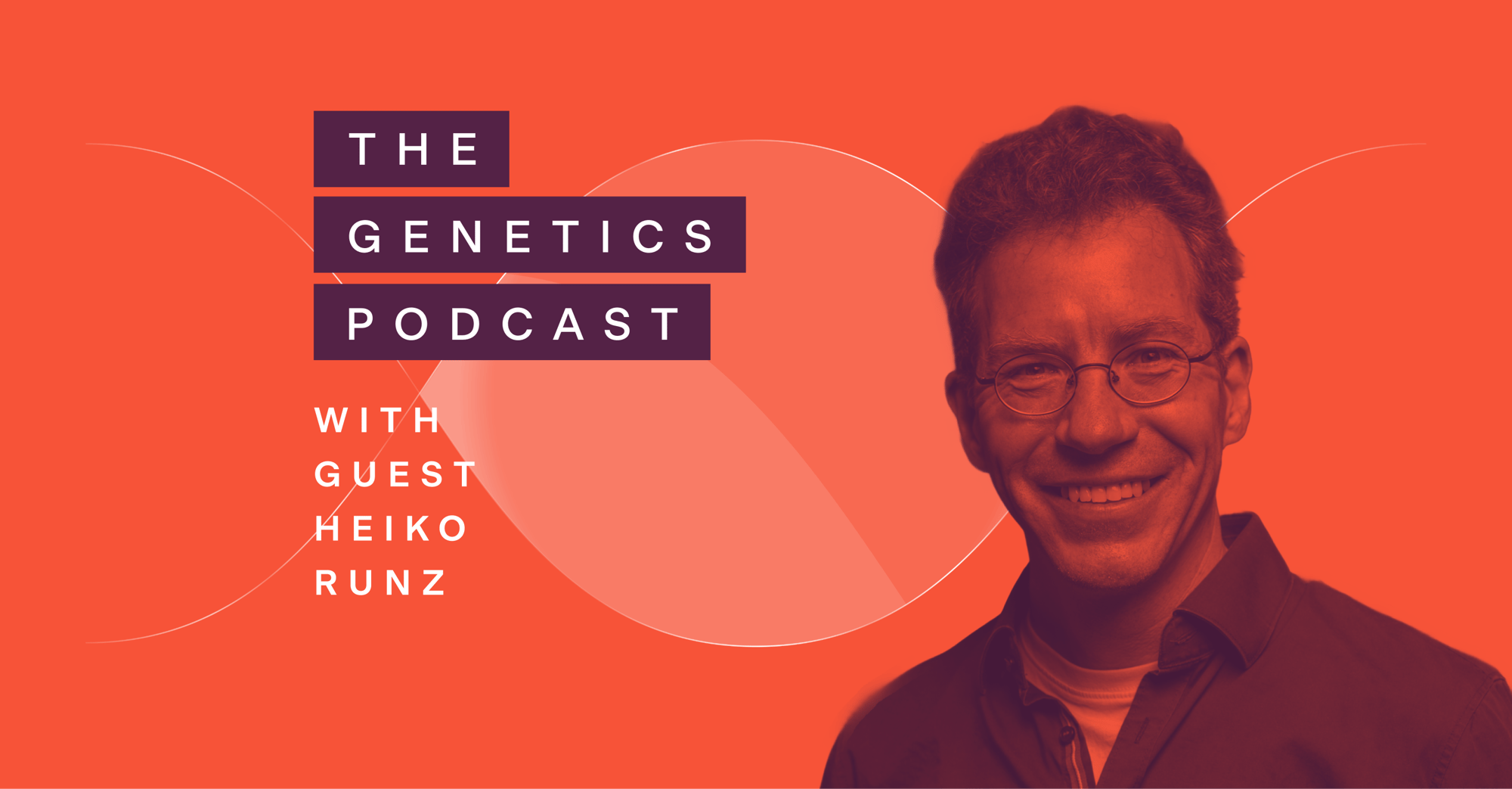
In the latest episode of The Genetics Podcast, we spoke with Dr. Heiko Runz, SVP of Neuroscience at insitro. With a background spanning clinical genetics, academic research, and leadership roles at Merck, Biogen, and now insitro, Heiko has helped pioneer the integration of human genetics into drug discovery. Today, he’s at the forefront of applying AI and large-scale biobank data to unravel the complexity of neurological disease and accelerate therapeutic development.
Clinical genetics to pharma: a career shaped by curiosity
Heiko began his career in clinical genetics in Germany, where he provided counseling and diagnostics for patients with rare diseases, particularly in pediatric settings. His early exposure to the promise and limitations of molecular testing sparked a desire to go deeper and understand their functional consequences.
That curiosity led him into experimental biology, where he developed high-throughput microscopy platforms to test gene function in disease-relevant cellular phenotypes. His academic work eventually took him to the Broad Institute, where he became immersed in the emerging world of population-scale exome data, and began building the bridge between clinical observation and large-scale genomic data interpretation.
Making biobanks actionable for therapeutic discovery
A major theme in Heiko’s work has been extracting value from large-scale biobanks like UK Biobank and FinnGen. Rather than using them solely for broad association studies, Heiko and his teams have used these resources to pinpoint individual variants (often rare loss-of-function mutations) that provide direct clues for therapeutic targets.
One of the most compelling examples discussed in the episode is the discovery of a CFHR5 loss-of-function variant that appears to protect against age-related macular degeneration (AMD). The finding emerged from a cross-biobank analysis of UK Biobank and Finnish data, followed by fine-mapping and functional validation. This work demonstrated how population genetics, when combined with clinical insight and lab validation, can powerfully inform target discovery.
Why sample recall and functional follow-up still matter
While large datasets offer scale and statistical power, Heiko stressed the importance of going beyond association. In the CFHR5 case, the team conducted a rare but impactful sample recall study in Finland to analyze proteomic changes linked to the variant. This approach enabled them to confirm that the genetic signal had functional consequences on the complement pathway, offering a plausible mechanism of action and a starting point for therapeutic development.
He acknowledged that such studies can be operationally challenging, but argued that they’re critical for moving from genetic hits to drug targets. He also called for more biobank initiatives to support on-demand biospecimen recall and in-depth phenotyping, which could unlock richer translational insights.
Connecting genes to function through cellular models
At insitro, Heiko is focused on closing the gap between genetic association and biological mechanism using advanced cell-based assays. These systems, which often rely on induced pluripotent stem cell (iPSC)–derived neurons, are used to screen the functional impact of gene perturbations at scale.
By combining high-content microscopy with CRISPR and RNAi tools, insitro can systematically identify genes that modify disease-relevant phenotypes. Heiko shared how these technologies not only help validate targets but also shed light on variant effects, pathway interactions, and combinatorial influences that are otherwise invisible in population data alone.
A new paradigm in ALS and neurodegenerative disease
Heiko also reflected on his work at Biogen, particularly in developing therapies for ALS. He was closely involved in the development of tofersen, a first-in-class antisense oligonucleotide therapy targeting SOD1-linked ALS. He described how genetic data helped stratify patients, inform trial design, and complement emerging biomarkers.
Today, at insitro, he is applying these learnings to broader forms of ALS and neurodegenerative diseases. In collaboration with Bristol Myers Squibb, his team is pursuing targets that modify TDP-43 mislocalization, a hallmark of ALS pathology beyond SOD1.
AI’s true role in drug discovery
While AI is often hyped in drug discovery, Heiko offered a grounded view of its most valuable applications. At insitro, AI is used to define and refine phenotypes in cellular assays and in population datasets, so that researchers can detect subtle patterns and make more confident decisions about which targets to pursue.
Rather than replacing scientists, Heiko sees machine learning as a force multiplier, especially when it’s embedded in experimental platforms that capture meaningful biological signals. The goal, he emphasized, is not just to generate predictions, but to enable better science that leads to better therapies.
Advice for early-career scientists
As someone who has worked across clinical medicine, academia, and industry, Heiko’s advice for those entering the field is to stay curious and avoid becoming too comfortable. Genetics, he said, is evolving rapidly, and careers in this space often benefit from embracing new disciplines and perspectives.
He encouraged scientists to explore areas outside their expertise, stay close to the biology, and look for opportunities to connect seemingly distant fields.
Listen to the full episode below.