
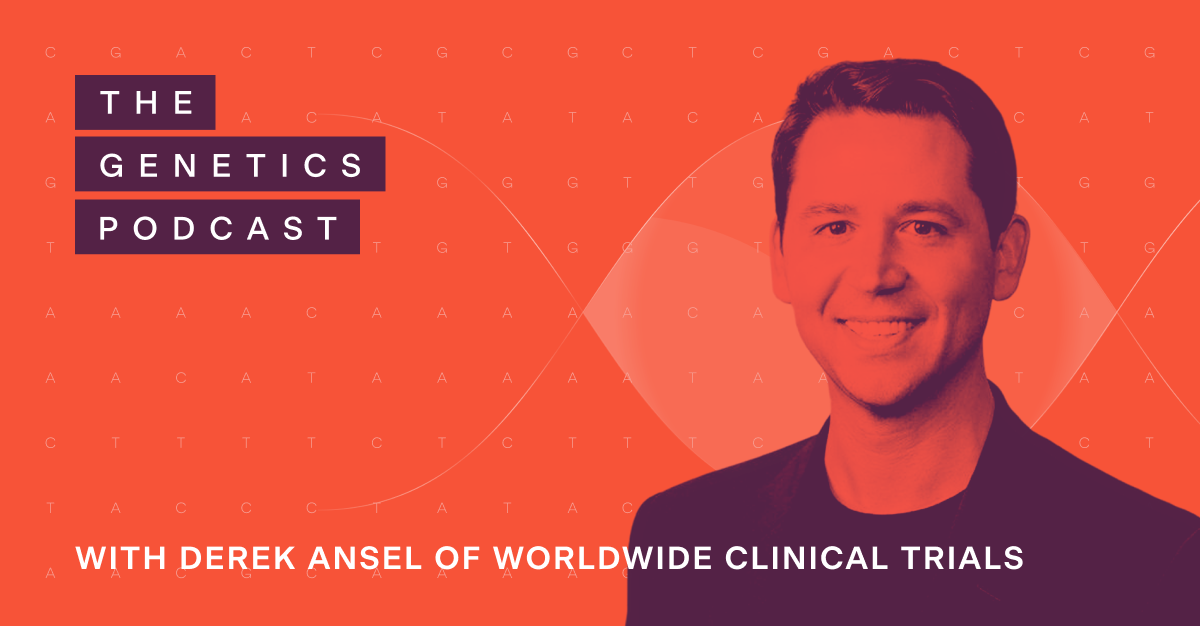
Podcast recap: Derek Ansel on decision-making under uncertainty in rare disease clinical trials
 By Joy N. Ismail, PhD
Rare disease drug development involves decision-making under extreme uncertainty. Teams are asked to design trials without well-established endpoints, in small and heterogeneous populations, often with limited natural history data and no prior approvals to learn from. For many programs, there is only one realistic shot to generate a clear signal. The cost of getting those early decisions wrong is high.
In the latest episode of The Genetics Podcast, Patrick Short spoke with Derek Ansel, Global Vice President and Therapeutic Strategy Lead for Rare Disease and Oncology at Worldwide Clinical Trials. Drawing on experience across clinical operations, genetic testing, and patient engagement, Derek outlines how trial teams navigate this uncertainty in practice, from endpoint selection to patient strategy, and how new regulatory frameworks and technologies may start to shift the balance.
Why endpoint selection remains one of the hardest problems in rare disease
As Derek explains, endpoint selection is still one of the central challenges in rare disease clinical development. Many rare conditions are poorly characterized, and even within a single disease, patients may present very differently. That makes it difficult to define a single measure that can reliably demonstrate efficacy.
In neurodevelopmental and multisystem disorders especially, symptoms can vary widely across patients. Some may experience regression, seizures, or major developmental delays, while others may follow a very different course. That heterogeneity makes it difficult to choose endpoints that are both clinically meaningful and acceptable to regulators.
To address this, sponsors and contract research organizations (CROs) often draw on multiple sources of evidence, including literature reviews, precedent from related diseases, translational science, and natural history data. The goal is not just to choose an endpoint that sounds reasonable on paper. It is to find one that can be operationalized in the clinic, measured consistently, and used to reduce uncertainty about whether a therapy is working.
A key theme from Derek’s perspective is that trial design should reduce noise and produce a usable signal. That means endpoint strategy, patient selection, and operational feasibility all have to work together.
Patient selection is a strategic decision
Rare disease trial design also depends heavily on how broadly or narrowly a sponsor defines the target population. Narrower inclusion criteria can reduce heterogeneity and improve the chances of detecting a treatment effect, but they can also make recruitment harder.
That tension is especially important in gene therapy and other advanced therapeutics, where sponsors may need to decide whether to start with earlier stage patients who could benefit more, or later stage patients whose disease progression may make effects easier to measure in a shorter timeframe.
Derek emphasizes that there is no universal formula here. These decisions depend on the asset, the disease, the level of existing precedent, and the sponsor’s long term commercialization goals. In many cases, starting with a narrower group can be the most practical way to establish proof of concept before expanding to a broader population later.
Why the FDA’s plausible mechanism framework matters
One of the most timely parts of the conversation is Derek’s take on the FDA’s evolving stance toward rare disease development, especially around the Plausible Mechanism pathway.
He sees this as an encouraging signal that regulators recognize the need for approaches that better fit ultra-rare and genetically defined conditions, including n-of-1 therapies and platform-based strategies. Instead of forcing every program through the same traditional development path, these frameworks suggest a willingness to consider strong mechanistic evidence and reduce unnecessary duplication.
For developers working in monogenic disease, that matters. Genetics often provides unusually strong causal evidence, and the ability to link mechanism, target, and phenotype more directly could eventually make development faster and more efficient.
Genetic counselors have a bigger role to play in therapeutics
One of the strongest themes in the episode is Derek’s view that genetic counselors have an increasingly important role in the future of genetically targeted drug development.
As more therapies depend on genetic diagnosis, families are coming to clinics with more specific questions. They want to know whether testing could change medical management, whether an experimental therapy is worth waiting for, and how to think about competing options in diseases with multiple emerging programs.
Those questions are often more complex than they first appear. In some gene therapy studies, for example, enrolling in one trial may make a patient ineligible for future gene therapy programs. For families, the decision is not just whether to participate. It may be which one time intervention to pursue, with incomplete data and major implications for the future.
Derek argues that genetic counselors are especially well placed to navigate these conversations because they understand both the testing landscape and the broader ethical, practical, and family level consequences of these decisions. At the same time, demand is likely to outpace the current workforce, which means the wider clinical and research ecosystem will also need better education around genetics, consent, access, and long-term treatment strategy.
This challenge becomes even more visible in genetic subtypes of common diseases, where patients and clinicians may not be as used to thinking of the disease through a genetics lens. In areas like Parkinson’s disease, that creates a very different engagement and education landscape than in more traditionally monogenic rare disorders.
The financial model for rare disease therapy still lags behind
The conversation also explores n-of-1 therapies, which Derek sees as one of the clearest examples of innovation driven by necessity in rare disease. The science is progressing, and regulatory thinking appears to be moving in a more supportive direction.
The major bottleneck is shifting to access and financial sustainability. Developing a therapy for a single patient challenges the standard drug development model. Venture funding may be harder to secure, manufacturing is highly individualized, and reimbursement remains deeply uncertain. Even conventional gene therapies still face major access and payment hurdles, so the challenge is even more acute for therapies built around a single case.
This means the next phase of progress will require more than scientific proof. It will require new thinking around reimbursement, incentives, and the infrastructure needed to turn bespoke therapies into a viable part of the treatment landscape.
Where AI is helping clinical development today
Derek takes a pragmatic view of AI in clinical development. He sees real potential, particularly in document-heavy and labor-intensive workflows such as protocol drafting, literature review, data review, safety event summarization, and building systems that support data capture and analysis.
At the same time, he is cautious about inflated claims. Clinical development is tightly regulated, resource constrained, and often governed by processes where mistakes carry major consequences. For smaller biotech companies, the risks of hallucinations, inaccurate outputs, or overreliance on immature tools are especially serious.
His view is that companies should start small, test AI in specific workflows, and measure whether it genuinely improves speed or quality. That is a more realistic path than trying to apply AI everywhere at once.
This fits a broader point from the episode: in drug development, many of the true bottlenecks are still operational and external. AI may help teams work faster, but site activation, regulatory review, and real world execution still determine timelines in ways software alone cannot fix.
A useful window into how rare disease development is evolving
This episode is a valuable listen for anyone working in rare disease, precision medicine, or genetically targeted therapeutics. Derek offers a grounded view of what it takes to design and run trials in complex indications, where scientific uncertainty, operational constraints, and patient needs all intersect.
A few ideas stand out clearly:
- Rare disease trial design still depends on getting endpoints and patient selection right.
- Regulatory flexibility could unlock faster progress, especially for genetically defined conditions.
- Genetic counselors have an important role to play as therapeutics become more genomically driven.
- While new technologies like AI and n-of-1 platforms are opening up exciting possibilities, their impact will depend on how well the field solves the practical questions around implementation, evidence, and access.
Listen to the full episode below.