

 By Kim Hulse
Digital recruitment has become a standard part of clinical trial execution. Sponsors invest heavily in online outreach, patient referrals, and awareness campaigns to drive interest in studies. These efforts often succeed in generating clicks, sign-ups, and initial expressions of interest.
However, interest alone does not determine whether a trial succeeds. The metric that matters most is randomization. Trials fail or succeed based on whether eligible patients are randomized on time and in sufficient numbers. Understanding what predicts movement from click to randomization is now a core operational question for clinical development teams.
Why clicks don’t always predict trial success
Clicks, impressions, and cost-per-click are easy to measure and widely reported. They provide insight into reach and engagement but offer limited information about whether a trial will enroll successfully.
Many trials with strong digital performance still struggle to randomize patients. High engagement at the top of the funnel doesn't necessarily mean that patients will reach randomization.
For sponsors, this creates a false sense of progress early in a trial. High top-of-funnel activity can mask downstream bottlenecks that only become visible once timelines are already at risk.
The click to randomization pathway
To understand what predicts success, it is useful to look at the full pathway from first interaction to randomization. This pathway typically includes:
- Initial click or referral
- Eligibility screening and informed consent
- Genetic testing and counseling (if applicable)
- Site handoff and scheduling
- Consent at site
- Randomization
Each step introduces friction. The cumulative effect of these transitions determines whether a patient ultimately enrolls. Importantly, most drop-offs do not occur at the moment of initial outreach. They occur at handoffs between systems, teams, and timelines.
Predictor 1: Precision in eligibility screening
Trials that randomize efficiently invest early in eligibility precision. Broad outreach paired with imprecise screening creates volume but not velocity. Patients who appear eligible early but are later excluded increase burden on sites and on patients themselves, while slowing enrollment.
High-performing trials translate protocol criteria into clear, patient-ready screening logic. This reduces false positives and ensures that patients who reach sites are genuinely likely to enroll.
Eligibility precision is especially critical in rare disease and genomics-enabled trials, where small populations amplify the cost of misclassification.
Predictor 2: Speed of follow-up after interest
Time to first contact is one of the strongest predictors of progression. Patients who express interest are most likely to continue when follow-up happens quickly and clearly.
Delays of days or even hours can result in disengagement. Patients may lose confidence, pursue other care options, or simply stop responding.
Trials that prioritize rapid human follow-up after screening consistently see higher rates of site attendance and consent.
For example, in a gene therapy study supported by Sano Genetics, 95% of participants who completed eligibility went on to order a genetic testing kit, suggesting that when follow-up is immediate and clear, patients convert at exceptionally high rates.
Predictor 3: Site readiness and workflow alignment
The number of activated sites is less important than site readiness. Sites vary widely in staffing capacity, experience with the protocol, and ability to integrate referrals into existing workflows.
Trials that randomize on time tend to work with fewer, better-prepared sites. These sites have clear processes for intake, scheduling, and communication with referred patients.
Site readiness also includes alignment with digital referral pathways. When site teams understand where patients are coming from and what information they have already received, handoffs are smoother and drop-off is reduced.
Predictor 4: Transparent and consistent communication
In the click-to-randomization pathway, the highest-risk drop-offs often occur during transitions, when responsibility shifts between digital recruitment, central coordination, genetic testing, and site teams.
Trials that randomize efficiently reduce uncertainty at these moments by maintaining clear, consistent communication about what happens next, who will follow up, and when. In a study on participant feedback, 88.5% of participants reported wanting to receive trial results, and many expressed a desire for regular updates throughout the study. Participants also tend to prefer personalized communication, while investigators often default to written or online summaries.
Operationally, even short delays without explanation after eligibility confirmation or genetic test results can lead to disengagement. High-performing trials address this by using structured outreach, defined follow-up windows, and clear ownership between teams so patients are not left waiting between steps such as scheduling, consent, and site visits.
Transparent communication is an operational control point that preserves momentum through the most fragile parts of enrollment.
Predictor 5: Trust built early in the process
Trust is cumulative and begins before a patient ever reaches a site. Patients who understand why they are eligible, how their data will be used, and what participation involves are more likely to proceed through consent and randomization.
Early transparency supports later decision-making. This is especially relevant in trials involving genetic testing, rare diseases, or novel therapeutic modalities.
When trust is established early, downstream steps such as consent, randomization, and post-randomization participation become more predictable.
Why randomization-first thinking matters
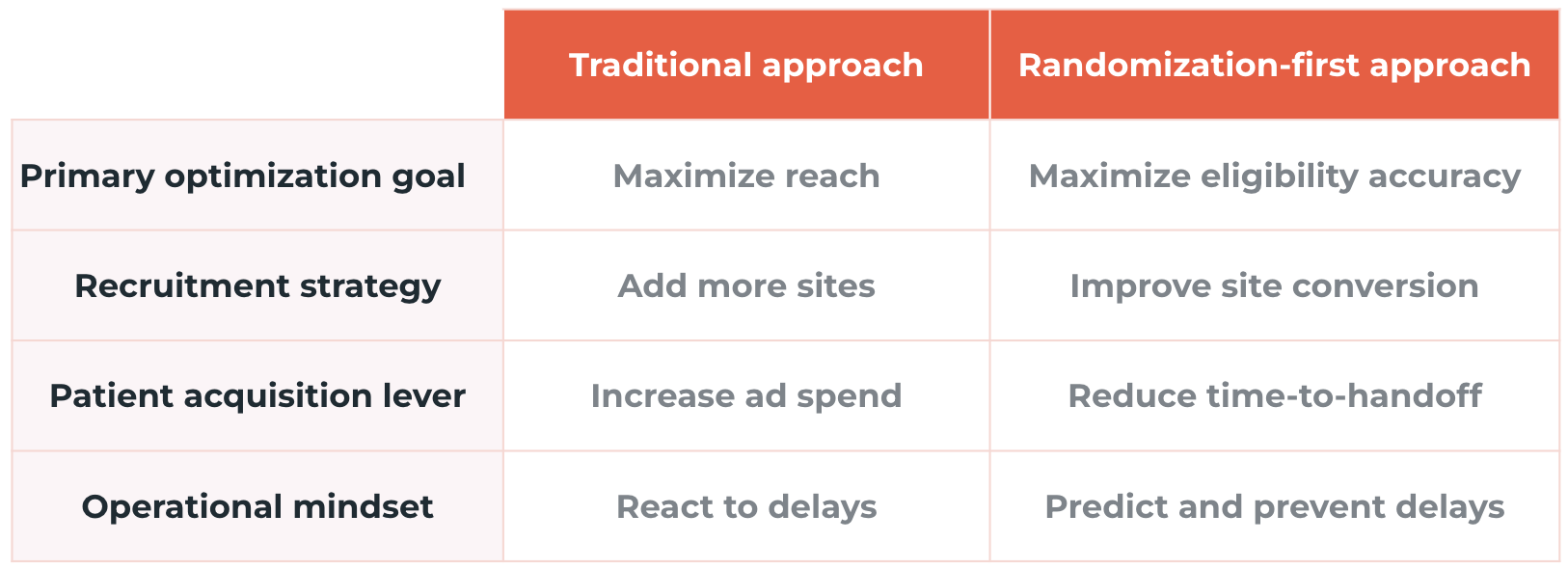
Focusing on randomization changes how trials are designed and executed. Teams that adopt a randomization-first mindset prioritize:
- Eligibility accuracy over raw reach
- Speed and clarity over volume
- Site performance over site count
- Early signals over retrospective fixes
This approach allows issues to be identified earlier, when adjustments are still possible.
Implications for clinical development teams
For sponsors, CROs, clinical operations leaders, and precision recruitment vendors, the path from click to randomization offers actionable signals. Monitoring where patients disengage provides insight into protocol design, site selection, and operational workflows.
Trials that succeed are not those with the most interest, but those that convert qualified interest into timely randomization. As digital and decentralized approaches continue to expand, understanding and optimizing this pathway will remain central to trial success.
To learn how Sano applies a randomization-first approach in practice by improving eligibility accuracy, accelerating site handoffs, and enabling higher site conversion, read our case study, How site enablement and activation became the strongest recruitment channel for a complex genetic trial.