


The challenge is not any single step in isolation. It is the lack of coordination between them. Recruitment, genetic testing, eligibility confirmation, and ongoing patient engagement are each managed separately in most precision trials, creating gaps where patients disengage, data is lost, and timelines slip. As precision medicine continues to move from a broad, one-size-fits-all model toward approaches that account for individual variability in genes, environment, and lifestyle, the operational infrastructure supporting these trials needs to keep pace.
Sano Genetics addresses this by unifying these steps within a single platform, connecting patient finding, pre-screening, genetic testing, and long-term engagement into one coordinated system. The result is fewer handoffs, greater visibility across the enrollment funnel, and a more consistent experience for patients and study teams alike.
Key Takeaways
- 90% of clinical trials fail to meet enrollment goals on time, often requiring double the original timeline.
- Adding genetic components to clinical trials significantly increases recruitment complexity.
- Sano Genetics offers an end-to-end platform combining genetic testing, recruitment, and engagement.
- The platform is designed to streamline operations and accelerate precision medicine research.
Where precision medicine trials break down
Precision medicine is advancing across multiple therapeutic areas, from precision oncology and pharmacogenomics to rare diseases. In each of these areas, trials increasingly require patients to meet genetic or biomarker-defined eligibility criteria. This creates operational demands that traditional trial infrastructure was not designed to handle.
Several challenges recur across precision medicine programs:
- Patient identification is constrained. Eligible patients are defined by genetic profile, not just diagnosis. Finding them requires screening broader populations and coordinating testing before enrollment can begin.
- Workflows are fragmented. Recruitment, genetic testing, consent, and engagement are typically managed by separate vendors with separate systems. Each transition introduces delay and the risk of patient drop-off.
- Engagement gaps compound over time. Precision trials often involve longer qualification pathways. Without sustained communication and support, patients disengage between steps.
- Data does not persist across programs. When recruitment is treated as a single-use activity, the insights and patient relationships built during one study are lost before the next one begins.
A coordinated approach
Sano's platform is designed to address these challenges as a connected system rather than a set of point solutions. By integrating recruitment, pre-screening, at-home genetic testing, and long-term engagement within one infrastructure, it reduces the handoffs and information gaps that slow enrollment and erode patient trust.
This matters because the trajectory of precision medicine points toward greater specificity, not less. As therapies target narrower genetic populations, the ability to find, qualify, and retain the right patients becomes the primary constraint on trial execution. A platform that coordinates these steps, and maintains patient relationships across studies, is not a convenience. It is the operational layer that determines whether precision programs can deliver on their promise.
The infographic below outlines how these capabilities connect across the patient journey.
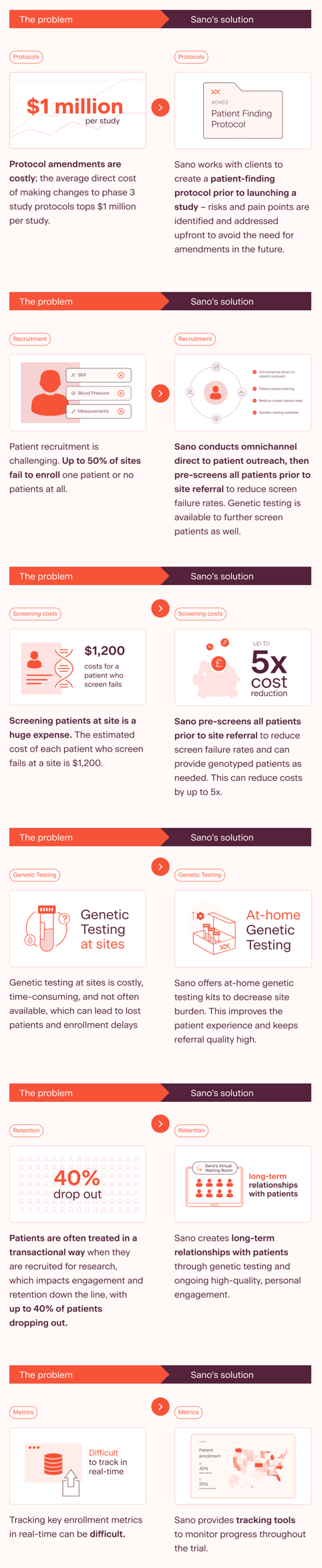
For clinical trial sponsors, these principles translate directly into operational requirements. Predictive and preventive goals depend on accurate genetic data. Personalization requires participants who match specific biological profiles. Participation depends on sustained engagement throughout the trial. Each of these elements needs to be supported systematically for a precision medicine study to run as designed. To learn more, get in touch.