
- DNA testing identifies specific genetic mutations that increase the risk of developing Parkinson's disease.
- Genetic insights help patients and clinicians understand the underlying causes of the disorder.
- Testing provides a foundation for exploring personalized treatment options and clinical trial eligibility.
- A comprehensive approach to PD includes evaluating both genetic markers and environmental influences.
DNA testing has become a practical tool for identifying mutations associated with increased Parkinson's risk. For patients, it can clarify the genetic dimension of their diagnosis. For clinical research teams, it is a critical step in qualifying participants for trials that target specific genetic pathways.
Key genes linked to Parkinson's disease
Researchers have identified several genes where mutations are associated with Parkinson's. While new genetic links continue to be discovered, the following are among the most well-characterized:
- SNCA: Produces alpha-synuclein, which accumulates in Lewy bodies in brain cells. Mutations linked to early-onset PD.
- LRRK2: One of the most commonly identified genetic contributors; associated with late-onset PD and autosomal dominant inheritance.
- GBA: Among the most prevalent genetic risk factors; also a focus of gene-targeted clinical trials.
- PARK2 (PRKN): Encodes parkin; autosomal recessive, requiring altered copies from both parents.
- PINK1: Protects mitochondria from stress; autosomal recessive and associated with early-onset PD.
- PARK7: Causes a rare form of early-onset PD; protein DJ-1 protects against mitochondrial stress.
The inheritance pattern matters. LRRK2 and SNCA follow autosomal dominant patterns (one altered copy sufficient). PARK2, PINK1, and PARK7 follow autosomal recessive patterns (both copies must be altered; parents may carry the mutation without symptoms).
Importantly, carrying a mutation does not guarantee a Parkinson's diagnosis. Environment and aging interact with genetic predisposition to influence whether and when the disease develops.
Beyond genetics: environment, aging, and combined risk
Genetics is one dimension of Parkinson's risk, but it does not operate in isolation. Environmental exposures, including pesticides, herbicides, and certain industrial chemicals, have been associated with increased risk, though the evidence remains complex and not fully conclusive.
Aging is the single greatest risk factor for Parkinson's disease. As cells age, they become more susceptible to damage, and changes in gene expression over time may trigger the cellular events that lead to neurodegeneration.
For most people with Parkinson's, the cause is a combination of these factors rather than any single trigger. This is why genetic testing is valuable but not deterministic — it provides one important piece of the picture, helping individuals and clinical teams understand the genetic component of their risk profile and whether they may be eligible for research programs targeting specific genetic pathways.
How DNA testing connects to Parkinson's clinical trials
A growing number of clinical trials for Parkinson's disease are designed around specific genetic targets. These gene-targeted trials test therapies aimed at biological mechanisms driven by mutations in genes such as LRRK2, GBA, and SNCA. Participation requires confirmation that a patient carries the relevant variant.
DNA testing is therefore a practical requirement for accessing an expanding class of precision therapies in development. Without genetic confirmation, patients who might otherwise qualify cannot be screened.
For clinical research teams, this creates a specific operational challenge. Identifying, testing, and confirming genetically eligible patients involves recruitment, consent, sample collection, lab coordination, result interpretation, and often genetic counseling. When these steps are fragmented across separate vendors and workflows, delays and drop-off rates increase.
Sano Genetics supports sponsors and clinical teams across this entire pathway — from patient identification through genetic testing, counseling coordination, and long-term engagement — within a single, compliant platform.
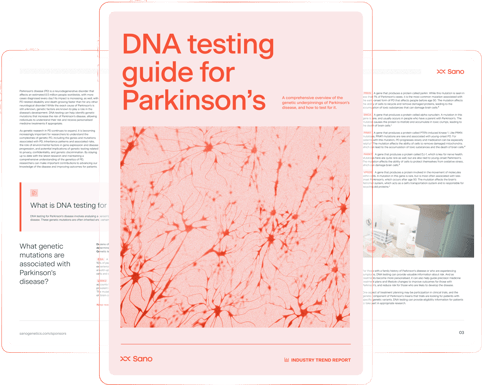
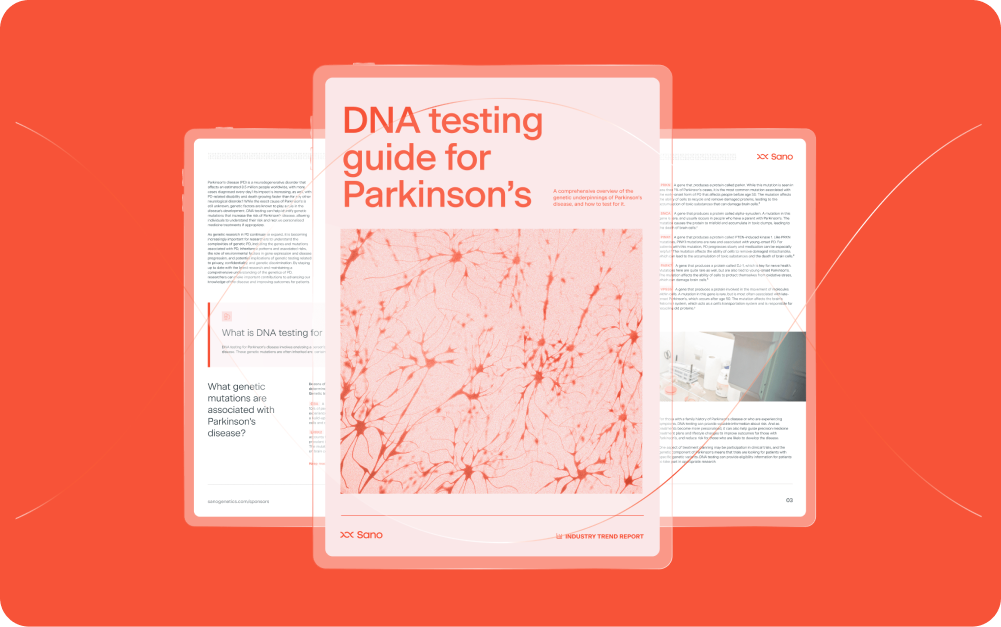
Our DNA testing guide for Parkinson's disease provides a detailed look at the genetic landscape of PD and the practical considerations for testing. It covers:
- The primary genetic mutations associated with Parkinson's risk
- How DNA testing works and what the process involves
- The role of environmental and combined risk factors
- Ethical and privacy considerations around genetic data
- How genetic testing connects to clinical trial eligibility and precision medicine
To discuss how Sano can support your Parkinson's programs, get in touch.